
Utah doesn't have a state disability insurance program, but you can get federal Social Security or SSI disability benefits in Utah.
Written and Edited by Lawyers
All articles on DisabilitySecrets.com have been written or edited and fact-checked by our in-house attorney editors, who together have over 35 years of experience practicing and covering disability law. Learn more about our team and our editorial standards.
According to the most recent available data, about 2.2% of Utah residents receive Social Security Disability Insurance (SSDI) and 1% receive Supplemental Security Income (SSI). While these benefits are federally funded, each state has its own agency—usually called Disability Determination Services, or DDS—that helps the Social Security Administration decide claims for benefits in that state. (In Utah, DDS is a part of Workforce Services Rehabilitation.)
Even though the application process is the same nationwide, there are regional differences in approval ratings. If you’re unable to work full-time for at least one year, and are considering filing for SSDI or SSI, you should be aware of the federal disability requirements as well as the approval ratings specific to Utah. Knowing how to navigate the application and appeals process at the state level—and beyond—can greatly increase your chances of a successful claim.
In This Article
- How to Apply for SSDI or SSI in Utah
- What Medical Conditions Qualify for Disability in Utah?
- How Likely Am I to Be Approved for Disability in Utah?
- Why Was My Disability Claim Denied?
- Appealing a Disability Denial in Utah
- How Much Can I Get in Disability Benefits in Utah?
- Benefits for Utah Veterans
- Vocational Rehabilitation Services in Utah
- Should I Get a Utah Disability Lawyer?
How to Apply for SSDI or SSI in Utah
Submitting your application for Social Security benefits is a fairly straightforward process. You’ll start by completing Form SSA-16, which you can submit electronically, over the phone, or in person. (You can learn more in our article about filing a disability claim with Social Security.) Below you can find the contact information for your preferred method of filing.
- File online at ssa.gov. This method has many benefits, such as giving you the option to save your application and return to it later. You’ll also receive a confirmation number where you can track your application.
- Call Social Security’s national number at 800-772-1213 from 8:00 a.m. to 7:00 p.m., Monday through Friday, to speak with a representative. If you’re deaf or hard of hearing, you can use the TTY number at 800-325-0778.
- Go in person at your local Social Security field office. You can use the locator toolhere to find the office closest to you.
After you’ve taken the initial step of handing in your application, Social Security will make sure that you meet the technical qualifications for receiving benefits. (SSDI eligibility is based on your work history, while SSI is a needs-based benefit with income and asset caps). Your file is then passed on to Utah’s DDS agency where a claims examiner—with help from a medical consultant—reviews your records and decides whether you’re disabled.
What Medical Conditions Qualify for Disability in Utah?
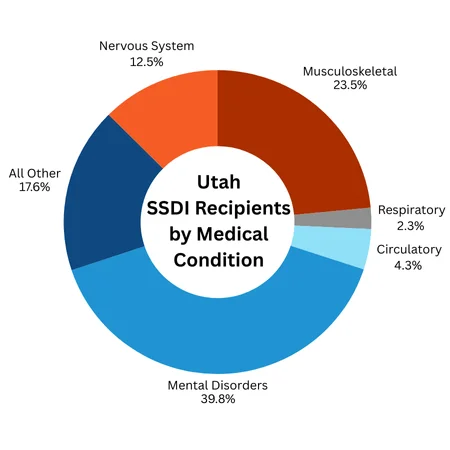
Any severe impairment may qualify you for disability benefits, provided that you have enough medical records to show that you either meet a listing or are unable to work at any job. In Utah, some of the most commonly awarded impairments are mental illnesses (such as anxiety or depression), musculoskeletal conditions (like back pain), and nervous system disorders (for example, diabetic neuropathy).
The chart below illustrates the percentage of SSDI recipients in Utah who were found disabled based on the most commonly awarded medical conditions.
Source: Annual Statistical Report on the Social Security Disability Insurance Program, 2023
The kinds of medical evidence you’ll need to provide will depend on your specific impairment. Claimants with back injuries, for example, should be ready with objective imaging like X-rays or MRIs showing spinal deformations, while mood impairments can be supported by mental status examinations establishing abnormal thought patterns. For more information, check out our article on what conditions qualify for Social Security disability benefits.
How Likely Am I to Be Approved for Disability in Utah?
Individually, your chances are higher the stronger your medical records are. Statistically speaking, however, 39.3% of disability claims in Utah were approved at the initial application stage—slightly greater than the national average of 38%—and 11.3% were approved following reconsideration review, a bit below the national average of 15.9%.
Most claimants in Utah aren’t awarded benefits until after they’ve had a hearing with an administrative law judge (ALJ). As of the fiscal year ending July 2025, Utah ALJs issued 1,640 decisions on disability claims. 906 of those decisions resulted in either fully or partially favorable outcomes, resulting in an approval rate of about 55%.
Why Was My Disability Claim Denied?
The exact reason why your claim was denied depends on your specific circumstances. Utah’s DDS must apply the Social Security five-step sequential evaluation process to determine whether you meet the agency’s definition of disability. Some of the most common reasons for a denial include:
- you don’t have enough medical records
- the medical records you do have don’t suggest significant functional limitations
- your functional limitations don’t keep you from performing a simple sit-down job, or
- you’re over the age of 50 and have transferable skills to other work.
Read your denial letter closely to determine why Utah DDS examiners didn’t award you benefits. The letter contains useful information that can help you strengthen your case on appeal.
Appealing a Disability Denial in Utah
You have 60 days after you’ve received a denial letter to submit your appeal. Your first appeal is called reconsideration, and it means that another claims examiner at DDS will review your file to see whether the initial denial was correct. Most people aren’t approved at reconsideration, so you’ll likely need to appeal further by requesting a disability hearing (again within 60 days after the reconsideration denial).
When you request a hearing, your case is sent from the Utah DDS to Social Security’s Office of Hearings Operations (OHO), located in Salt Lake City. You can find the contact information for this office below:
Salt Lake City OHO
125 South State Street
Suite 3102
Salt Lake City, Utah 84138
Phone: (877) 628-6579
Fax: (833) 748-0029
eFile Fax: (877) 486-2941
A judge at this office will schedule a time, date, and manner for you to speak with them and discuss your disabling conditions. In Utah, it takes about eight months between the time you request a hearing and when your hearing is conducted. After your hearing has concluded, the judge will review your testimony and write an opinion, which is usually mailed to you within several weeks.
How Much Can I Get in Disability Benefits in Utah?
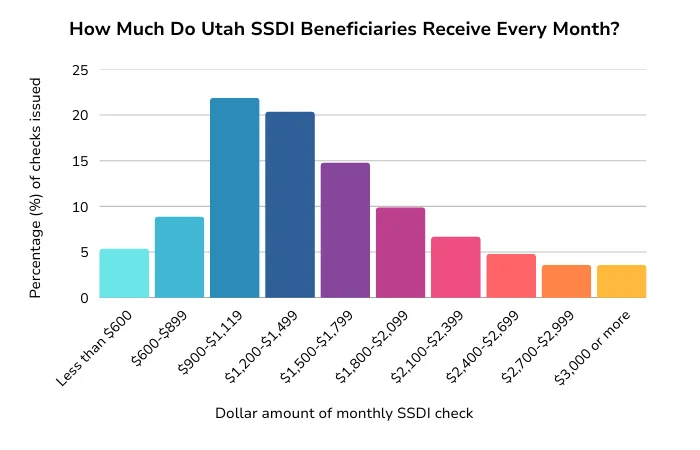
Because SSDI and SSI are federal benefits, the amount you’ll receive doesn’t change from state to state. SSDI payments are particularly tailored to each beneficiary since they’re calculated based on your individual earnings record, which can vary significantly between each person. The chart below shows the distribution of SSDI payments for Utah beneficiaries:
Source: Annual Statistical Report on the Social Security Disability Insurance Program, 2023
SSI payments are set annually by the federal government at a flat monthly rate that’s decreased if you have additional income. The state of Utah pays a tiny monthly supplement to residents who receive SSI benefits and live in a Medicaid-paid nursing home or other facility. This monthly supplement is paid in addition to the amount from the federal government ($967 in 2025).
SSI benefits are not subject to Utah state income tax. SSDI benefits are taxed by the state of Utah, but you’re able to claim a tax credit based on a certain percentage of your income as included on your federal income tax return (or your state taxable income, effective January 1, 2026). (Utah Code § 59-10-1042)
Benefits for Utah Veterans
Veterans who have a service-connected medical condition can get a disability rating from the VA. (Your rating is a major factor in determining how much you can receive in monthly disability compensation.) While many veterans are aware of the VA benefits they’re entitled to, fewer might know about additional benefits provided by the state of Utah. These benefits can include reduced or free entry to state parks, hiring incentives for employers of veterans, and property tax credits for disabled vets. To learn more, visit the Utah Department of Veterans & Military Affairs.
Vocational Rehabilitation Services in Utah
The State of Utah offers services if you're having difficulty keeping a job or returning to work due to your disability. Under the Department of Workforce Services (DWS), you can apply for vocational rehabilitation to help with job evaluation, training, and placement. If you have questions that you’d like to discuss with a representative, you can contact your local DWS office for assistance. You may also want to check out the Utah Department of Health & Human Services webpage for people with disabilities.
Should I Get a Utah Disability Lawyer?
You aren’t obligated to hire an attorney at any stage of the disability determination process, but it’s often a good idea, especially if you've already been denied disability benefits. Consider contacting a lawyer for a free initial consultation to see if your case is strong enough to base an appeal on and find out what you need to do to strengthen your case. Your chances of winning an appeal are much higher if you're represented by a lawyer or advocate with experience in Social Security disability. Disability lawyers typically work on contingency—meaning they don’t get paid unless you win your case—so there’s little upfront risk in hiring one.

In This Article
- How to Apply for SSDI or SSI in Utah
- What Medical Conditions Qualify for Disability in Utah?
- How Likely Am I to Be Approved for Disability in Utah?
- Why Was My Disability Claim Denied?
- Appealing a Disability Denial in Utah
- How Much Can I Get in Disability Benefits in Utah?
- Benefits for Utah Veterans
- Vocational Rehabilitation Services in Utah
- Should I Get a Utah Disability Lawyer?