
Learn what percentage of SSDI and SSI claims in NC are approved and what you can do to appeal a denial.
Written and Edited by Lawyers
All articles on DisabilitySecrets.com have been written or edited and fact-checked by our in-house attorney editors, who together have over 35 years of experience practicing and covering disability law. Learn more about our team and our editorial standards.
North Carolina residents who have a medical impairment that keeps them from working full-time may qualify for Social Security Disability Insurance (SSDI) or Supplemental Security Income (SSI), the two federal benefit programs that offer assistance to disabled people. While the rules and regulations governing eligibility for disability benefits are made at the federal level, each state processes its own SSDI and SSI claims—meaning that approval rates and waiting times can vary between them.
So if you live in North Carolina and are thinking about applying for SSDI or SSI, you should become familiar with state-specific aspects of the disability determination process that can impact how quickly you receive benefits and how much you’ll receive if you’re awarded. Knowing what information Social Security is looking for can help you speed up the process and increase your chances of a successful claim.
In This Article
- How to File for Disability in North Carolina
- What Medical Conditions Qualify for Disability?
- Who Makes Disability Determinations in NC?
- How Do I Appeal if My Disability Application Was Denied?
- North Carolina Disability Approval Rates
- How Much Is Disability in NC?
- What If I Don’t Qualify for SSDI or SSI in NC?
How to File for Disability in North Carolina
Applying for disability benefits is a fairly straightforward process. You can choose from three different methods when filing for SSDI or SSI benefits:
- Use Social Security’s convenient online application tool. (Before you start, you may first want to read our article with tips for applying online.)
- Call the national hotline at (800) 772-1213 from 8 a.m. to 7 p.m., Monday through Friday, to speak with a representative. If you’re deaf or hard of hearing, you can use the TTY number at 800-325-0778.
- Visit your local Social Security field office to complete a paper disability application. There are about 30 field offices located throughout NC..
For more details—including what personal information you should have on hand when you apply—check out our article on filing a disability claim with Social Security.
After you submit your application, your local Social Security field office will first make sure that you meet the technical qualifications to receive benefits. If so, your file is then sent to North Carolina’s Disability Determination Services (DDS) to decide whether you’re medically eligible.
What Medical Conditions Qualify for Disability?
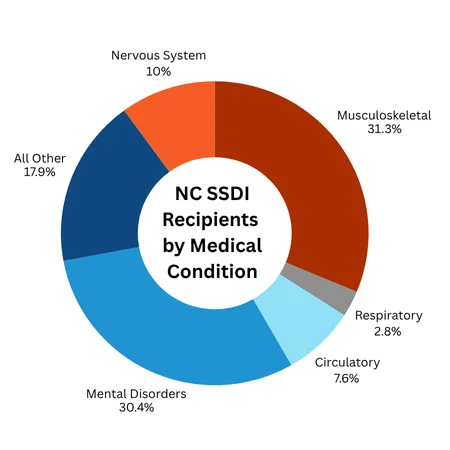
Any severe impairment may qualify you for disability benefits, provided that you have enough medical evidence to show that you either meet a listing or are unable to work at any job. In North Carolina, some of the most commonly awarded impairments are mental illnesses (such as anxiety or depression), musculoskeletal conditions (like back pain), and nervous system disorders (for example, diabetic neuropathy).
The chart below illustrates the percentage of SSDI recipients in NC who were found disabled based on the most commonly awarded medical conditions.
Source: Annual Statistical Report on the Social Security Disability Insurance Program, 2023
Your medical records are the foundation of your disability claim. Because retrieving and submitting those records can be expensive, North Carolina places a limit on how much a doctor’s office or hospital can charge you for your records. Medical providers can charge $0.75 per page for the first 25 pages, $0.50 for pages 26 through 100, and $0.25 for each page over 100, with a minimum fee of $10. (NC Gen Stat § 90-41.1 (2025)). A doctor can also charge a reasonable fee to review your records and write a short description of your treatment and condition based on the records.
Who Makes Disability Determinations in NC?
A claims examiner at North Carolina’s DDS will review your records—with help from a medical consultant—and make the initial decision about whether you qualify for disability. DDS claims examiners also review cases for claimants who’ve requested reconsideration, the first stage of appeal following an initial denial.
In recent years, the average time it takes for examiners at NC DDS to make an initial disability determination is 180 days, or about six months. (Source: Staffing, Productivity, and Processing Times at State Disability Determination Services, July 2025.) Reconsideration review takes a bit longer, averaging 213 days (around 7 months). To check the status of your claim while it’s being worked on at DDS, you can call 866-542-8113.
How Do I Appeal if My Disability Application Was Denied?
At each stage of the review process, you have 60 days from when you receive a denial letter to appeal a decision that you disagree with. If you’re denied the first time, your next step is to request that DDS reconsider your claim. After reconsideration, if you’re denied again, you can ask for a disability hearing with an administrative law judge.
Disability judges aren’t employees of DDS. Instead, they work for Social Security’s Office of Hearings Operations (OHO). When you request a hearing, your case file is sent from DDS to one of the six OHO offices that conduct hearings for North Carolina residents. You can find the contact information for these OHO offices below.
| Charlotte 2201 Coronation Boulevard, Suite 200 Charlotte, North Carolina 28227 Phone: (888) 397-4124 Services the following field offices: Albemarle, Charlotte, Concord, Hickory, Gastonia, Salisbury, Shelby, and Statesville |
Fayetteville 150 Rowan Street, 2nd Floor Fayetteville, NC 28301 Phone: (888) 552-7169 Services the following field offices: Fayetteville, Kinston, New Bern, Lumberton, Rockingham, Sanford, Wilmington, and Whiteville |
| Greensboro 101 South Edgeworth St., Suite 300 Greensboro, North Carolina 27401 Phone: (866) 690-2091 Services the following field offices: Greensboro, Reidsville, and Wilkesboro |
Raleigh 4800 Falls of Neuse Rd., Suite 200 Raleigh, North Carolina 27609 Phone: (866) 708-3174 Services the following field offices: Ahoskie, Durham, Elizabeth City, Goldsboro, Greenville, Henderson, Raleigh, Roanoke Rapids, Rocky Mount, Smithfield, Washington, and Wilson |
| Charleston, SC Suite 300 3875 Faber Place Drive North Charleston, SC 29405 Phone: (877) 405-1467 Services the Wilmington, NC field office |
Greenville, SC 475 North Main Street Mauldin, SC 29662 Phone: (866) 827-6721 Services the Franklin and Hendersonville field offices |
As of August 2025, the average time it takes from when you request a hearing in North Carolina to the date when your hearing is held is 7 months. You may be able to speed up the process by requesting that your hearing be conducted over the phone or using videoconferencing, but you always have the right to an in-person hearing. If you’re not sure which “manner of appearance” to choose, check out our article about video hearings that discusses some of the pros and cons.
North Carolina Disability Approval Rates
Statistically claims examiners at North Carolina DDS approved 37% of disability applications at the initial level, in line with the national average of 38.3%. The approval rate after reconsideration review is 16.2%—again around the national average of 15.9%.
At the hearing stage, for the fiscal year ending July 2025, judges in offices handling NC disability claims issued decisions on 13,475 disability claims. 8,756 of those decisions resulted in either fully or partially favorable outcomes, for an approval rate of about 64%.
How Much Is Disability in NC?
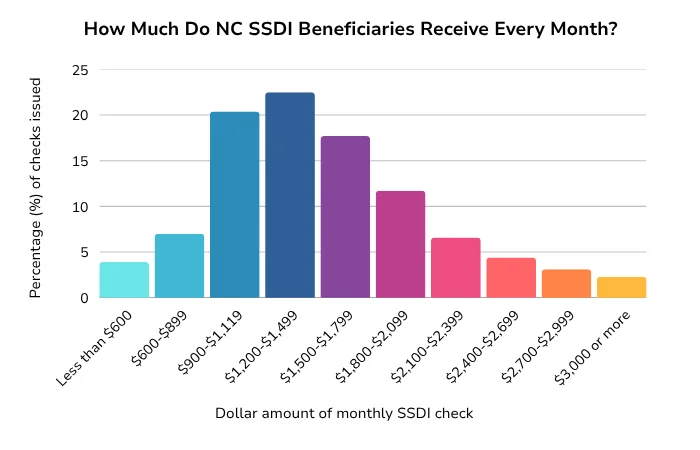
Because SSDI and SSI are federal benefits, the amount you’ll receive doesn’t change from state to state. SSDI payments are particularly tailored to each beneficiary since they’re calculated based on your individual earnings record, which can vary significantly between each person. Below is a chart showing the distribution of SSDI benefit amounts for North Carolinians:
Source: Annual Statistical Report on the Social Security Disability Insurance Program, 2023
SSI payments are set annually by the federal government at a flat monthly rate ($967 in 2025) that’s decreased if you have additional income. For beneficiaries who live in an adult care home or receive in-home support services, North Carolina provides a state supplementary payment, called the Special Assistance Program, on top of the federal payment. The Special Assistance Program helps pay the room and board for SSI recipients living in residential care facilities. The program also provides a modest monthly stipend (about $70) as a personal needs allowance. You can apply for the program by contacting your local NC Department of Social Services office.
What If I Don’t Qualify for SSDI or SSI in NC?
Not everybody with a medical impairment will qualify for Social Security disability benefits. Many claimants aren’t legally eligible for either SSDI or SSI, while others may meet the technical requirements but are unable to show that no jobs exist that they can still do despite their medical impairments.
If, after reviewing Social Security’s decision to deny you benefits, you want to try to return to work, North Carolina does offer vocational rehabilitation and retraining services through the Division of Health and Human Services. This agency provides assistance to disabled individuals with job placement, self-care skills, and helps to achieve independent living.
If you want to continue with your claim for SSDI or SSI—whether by appealing an unfavorable decision from a judge or by filing another application—consider getting help from an experienced disability lawyer. Your attorney can give you an honest assessment on the strengths and weaknesses in your claim, put any “bad facts” in the proper context , and gather helpful medical source statements that can tip the scales in your favor. (Check out our article on what Social Security disability lawyers do for more information.)

In This Article
- How to File for Disability in North Carolina
- What Medical Conditions Qualify for Disability?
- Who Makes Disability Determinations in NC?
- How Do I Appeal if My Disability Application Was Denied?
- North Carolina Disability Approval Rates
- How Much Is Disability in NC?
- What If I Don’t Qualify for SSDI or SSI in NC?