
Veterans can establish service connection by showing a link between a new or pre-existing condition and active duty.
Written and Edited by Lawyers
All articles on DisabilitySecrets.com have been written or edited and fact-checked by our in-house attorney editors, who together have over 35 years of experience practicing and covering disability law. Learn more about our team and our editorial standards.
A service-connected disability is an illness, injury, or disorder that resulted from military service. The VA can pay monthly compensation to veterans who can establish that they have a service-connected disability. The impairment can be mental or physical, but without evidence showing that the condition arose or got worse because of time on active duty, veterans won’t be able to qualify for VA disability benefits.
Some conditions are easy to show arose from active duty, while others are tougher to relate back to your service. Because the link between your current medical condition and your military history is such a key factor in deciding whether you can get VA compensation, it’s important to understand the five ways in which you can establish that your disability is service-connected.
How to Establish Service Connection
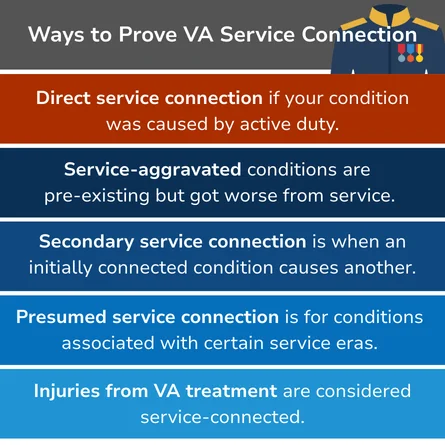
There are five methods of establishing service connection: direct, aggravated, secondary, presumed, and caused by VA care. Most, but not all, of these methods require the veteran to provide evidence of a “nexus” (causal link) between an in-service event and their current medical condition.
Direct Service Connection
Direct service connection occurs when there's a basic cause-and-effect relationship between an in-service event and a resulting medical condition. (Think of it as drawing a straight line from the incident and the impairment.) For example, a veteran who is paralyzed following a parachute landing will likely have a strong case establishing direct service connection.
Pre-Existing Condition Aggravated by Military Service
Veterans who already had a medical condition before they enlisted that was exacerbated by their time on active duty can establish “aggravated” service connection. For example, a veteran with psoriasis who was exposed to certain chemicals that made the disorder worse than it ever would have been on its own should be able to establish aggravated service connection. (Typically, the pre-existing impairment must be noted on the veteran’s initial medical exam.)
Secondary Service Connection
Secondary service connection exists when one service-connected disability is the cause of another disability. The second disability doesn’t need to be directly related to military service but wouldn’t have occurred without the first disability (the one caused by military service).
One case of secondary service connection involved a WWII veteran who was treated for tuberculosis using medicine known to cause hearing loss. While the veteran’s hearing loss wasn’t directly related to service, it wouldn't have occurred if not for the service-connected tuberculosis. More recently, veterans with service-connected fibromyalgia who have anxiety and depression due to the condition’s chronic pain symptoms can also have those mental health disorders considered for secondary service connection.
Presumed Service Connection
Certain conditions or diseases are "presumed" to be service-connected because they are so unlikely to occur outside of the time and place of service. For example, veterans who were exposed to Agent Orange during their military service and who now have Parkinson's disease are presumed to have a service connection. Veterans don’t have to prove a direct link between their current medical condition and their military service—the VA does it for them. These medical conditions are often referred to as “presumptive disabilities.”
The VA has a long list of conditions that are presumed to be service-connected, as long as they cause the veteran to be at least 10% disabled. The exact conditions vary depending on the location of your service and whether you were a prisoner of war. Some POWs are presumed to have service connection for disorders related to captivity of 30 days or longer, such as malnutrition or dysentery. Veterans who served in tropical environments have a presumed service connection for illnesses like malaria or West Nile virus, while those exposed to nuclear radiation have a presumed service connection for many kinds of cancer.
Time can also play a part in a presumed service connection determination. If your symptoms appear within one year after discharge, the VA will conclude that they're related to your service. This is the case even if your symptoms were not present during active duty.
Service Connection due to Injury Caused by Treatment in the VA Health Care System
Also known as a “Section 1151” claim, any injuries sustained by a veteran due to VA hospitalization, treatment, rehab, or therapy will be considered automatically service-connected. For example, a veteran who has complications from a failed back surgery performed at a VA hospital can establish service connection. (It’s difficult to get the VA to approve disability compensation based on this method, however, so thorough documentation of what went wrong during treatment in the VA health care system will be very important.)
Service-Connected Disability Pay Chart
The VA doesn’t pay benefits based on the type of service-connection you’ve established. Instead, the agency uses a combination of factors including your percentage disability rating and your living situation. Compensable (payable) disability ratings range from 10% to 100%, depending on how severe the condition is. Below is a chart that shows the range of monthly payments for 2026 based on an individual veteran’s disability rating.
|
10% rating |
20% rating |
30% rating |
40% rating |
50% rating |
|
$180.42 |
$356.66 |
$552.47 |
$795.84 |
$1,132.90 |
|
60% rating |
70% rating |
80% rating |
90% rating |
100% rating |
|
$1,435.02 |
$1,808.45 |
$2,102.15 |
$2,362.30 |
$3,938.58 |
Keep in mind that your exact amount can change depending on whether you’re married, whether your spouse is also a disabled veteran, and the number of dependents (parents and children) you support. You can find the current detailed tables corresponding to your situation at the VA webpage for veteran disability compensation rates.
Filing a Service-Connected VA Disability Compensation Claim
Filing for VA benefits is a fairly straightforward process. You'll need to complete Form 21-526EZ, Application for Disability Compensation and Related Compensation Benefits, which you can do in a few ways:
- Apply online using the electronic version of Form 21-526.
- Fax Form 21-526EZ to 844-531-7818 (from inside the United States) or 248-524-4260 (from outside the U.S.).
- Bring your application to your local VA office.
- Mail the form to the Department of Veterans Affairs, Claims Intake Center, PO Box 4444, Janesville, WI 53547-4444
If you are unsure whether or not the VA will consider your disability to be service-connected, you may want to talk to a veterans’ disability attorney. Having a lawyer to help you navigate the (often frustrating) VA system can be very beneficial, especially if you need to appeal a denial based on lack of service-connection or get a higher disability rating.
Talk to a Lawyer
Need a lawyer? Start here.
How it Works
- Briefly tell us about your case
- Provide your contact information
- Choose attorneys to contact you