
Learn what to expect in terms of waiting time and chances of approval when you apply for SSDI or SSI in Wisconsin.
Written and Edited by Lawyers
All articles on DisabilitySecrets.com have been written or edited and fact-checked by our in-house attorney editors, who together have over 35 years of experience practicing and covering disability law. Learn more about our team and our editorial standards.
If you live in Wisconsin and have a medical impairment that keeps you from working full-time for at least a year, you could be eligible for Social Security Disability Insurance (SSDI) or Supplemental Security Income (SSI) benefits. While these programs are run by the federal Social Security Administration, each state processes the disability claims for its own residents, resulting in different approval ratings and waiting times depending on where you live.
Wisconsinites who are considering filing for SSDI or SSI should become familiar with the state-specific aspects of the disability determination process that can impact how quickly you receive benefits and how much you’ll receive if you’re awarded. Knowing what information Social Security is looking for can help you speed up the process and increase your chances of a successful claim.
In This Article
- How to File for Social Security Disability in Wisconsin
- Should I File for SSDI or SSI?
- Who Makes Disability Determinations in Wisconsin?
- Medical Conditions That Qualify for Disability
- What Are My Chances of Getting Approved for Benefits in Wisconsin?
- Appealing a Denial to a Disability Hearing Office
- How Much Is Disability in Wisconsin?
- Wisconsin Vocational Rehabilitation Services
- How Can I Get Help with My SSDI or SSI Claim?
How to File for Social Security Disability in Wisconsin
The process of applying for disability benefits is the same no matter which state you live in. The Social Security Administration (SSA) offers several methods you can choose from when filing your claim for benefits.
- Apply online using the SSA’s electronic filing tool.
- Calling the SSA at 800-772-1213 to speak with a representative. You can apply for disability benefits by phone or you can set up an appointment to apply for Social Security in person (which may cut down on your wait time at the local SSA office).
- Visiting an SSA branch office to apply in person. You can find the nearest Social Security office in Wisconsin by visiting the SSA office locator.
For more details—including what personal information you should have on hand when you apply—check out our article on filing a disability claim with Social Security.
Should I File for SSDI or SSI?
Although many people use the terms SSDI and SSI interchangeably—and the definition of disability is the same for both programs—these two types of disability benefits each have their own preliminary eligibility criteria (“non-medical qualifications”) that you must satisfy in order to legally receive payment.
For SSDI, this means having enough work credits to be insured under the program on the date you became disabled. For SSI, this means having limited income and resources below a certain low threshold. You can file for both programs and let Social Security figure out which ones you qualify for, but you must be financially eligible to receive at least one of the two benefits. Otherwise, your application will be denied.
Who Makes Disability Determinations in Wisconsin?
After your Social Security field office gets your application, they’ll first make sure that you meet the technical qualifications to receive benefits. Your file is then passed on to a claims examiner at Wisconsin’s Disability Determination Bureau (DDB), who reviews your records with help from a medical consultant and decide whether you’re disabled.
DDB claims examiners will conduct the first (“initial”) medical review of your claim. In recent years, the average time it takes for examiners at Wisconsin DDB to make an initial disability determination is 186.6 days, or a little over six months. (Source: Staffing, Productivity, and Processing Times at State Disability Determination Services, July 2025.)
If you have questions for the claims examiner or need to submit additional medical records while your claim is being worked on at DDB, you should get in touch with the office using the contact information below.
|
Mailing Address |
Phone Numbers |
Fax Numbers |
|
Disability Determination Bureau |
Toll free: 800-423-1938 |
Toll free: 800-423-1939 |
Medical Conditions That Qualify for Disability
Any severe impairment may qualify you for disability benefits, provided that you have enough medical evidence to show that you either meet a listing or are unable to work at any job. In Wisconsin, some of the most commonly awarded impairments are mental illnesses (such as anxiety or depression), musculoskeletal conditions (like back pain), and nervous system disorders (for example, diabetic neuropathy).
The chart below illustrates the percentage of SSDI recipients in Wisconsin who were found disabled based on the most commonly awarded medical conditions:
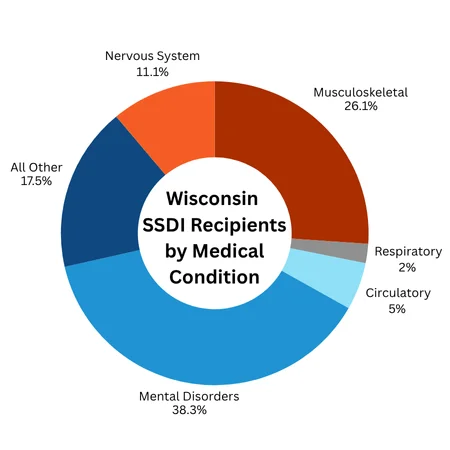
Source: Annual Statistical Report on the Social Security Disability Insurance Program, 2023
Your medical records are the foundation of your disability claim. Because retrieving and submitting those records can be expensive, Wisconsin places a limit on how much a doctor’s office or hospital can charge you for your records. Under Wisconsin state law, medical providers can’t charge more than the SSA reimburses the department for copies of health care records. (Wis. Stat. § 146.83(1f)(am)). The current SSA reimbursement rate is 10¢ per page, but there’s no fee if the total amount of copying and retrieval is less than $25. (20 C.F.R § 401.9).
What Are My Chances of Getting Approved for Benefits in Wisconsin?
Statistically, claims examiners at the Wisconsin DDB approved 41.2% of disability applications at the initial level, slightly higher than the national average of 38.3%. That means that almost 60% of applicants will be denied on their first try, and they’ll need to request reconsideration if they wish to continue pursuing their disability claim. Reconsideration is the first step in the disability appeals process. You have 60 days from when you receive your initial denial letter to request reconsideration review.
During reconsideration, a different claims examiner at DDB will review your file again and make a new decision on your case. (On average, reconsideration review takes 213 days, or about 7 months.) Unfortunately, DDB approves only about 17.2% of claims after reconsideration, but you’ll have to get denied again before you can ask for a hearing with an administrative law judge—where you stand your best chances of getting awarded benefits.
Appealing a Denial to a Disability Hearing Office
Following reconsideration, you have 60 days from receiving your denial letter to request a disability hearing. Once you request a disability hearing, your claim passes from examiners at the Wisconsin DDB office to Social Security’s Office of Hearings Operations, or “OHO.” Staff at OHO will schedule you for a hearing—either in-person, over the phone, or by video conference—with an administrative law judge who will ask you questions about your disability.
There are two OHO offices that handle disability cases in Wisconsin, located in Madison and Milwaukee. After your hearing has been requested, you should address any inquiries or submit new information to the OHO serving your geographic area instead of the DDB offices. You can find contact information for each OHO below.
|
Madison OHO Phone: (877) 600-2854 Services the following Social Security field offices: Eau Claire, Janesville, La Crosse, Lancaster, Madison, Portage, Rhinelander, Rice Lake, Wausau, and Wisconsin Rapids |
Milwaukee OHO Phone: (866) 495-0039 Services the following Social Security field offices: all Milwaukee offices, plus Appleton, Fond du Lac, Green Bay, Greenfield, Kenosha, Manitowoc, Marinette, Oshkosh, Racine, Sheboygan, Waukesha, and West Bend |
As of August 2025, it takes about eight months between the date you request your hearing and the date the hearing is held for both the Madison and Milwaukee OHOs. For fiscal year 2025, judges at Wisconsin OHOs heard 3,057 disability hearings and issued fully or partially favorable decisions in 1,981 of those cases, resulting in an approval rating of about 64%.
If you receive an unfavorable decision from the hearing judge, you have additional opportunities to appeal. First, you can ask the Social Security Appeals Council to review your claim for reversible error, meaning the judge made a mistake of fact or law that would have changed the outcome of your case. If the Council doesn’t pick up your claim for review, you can file a case in federal court. Relatively few Wisconsin disability claims are approved at these last two levels.
How Much Is Disability in Wisconsin?
Because SSDI and SSI are federal benefits, the amount you’ll receive doesn’t change from state to state. SSDI payments are particularly tailored to each beneficiary since they’re calculated based on your individual earnings record, which can vary significantly between each person. Below is a chart showing the distribution of SSDI benefit amounts for Wisconsinites:
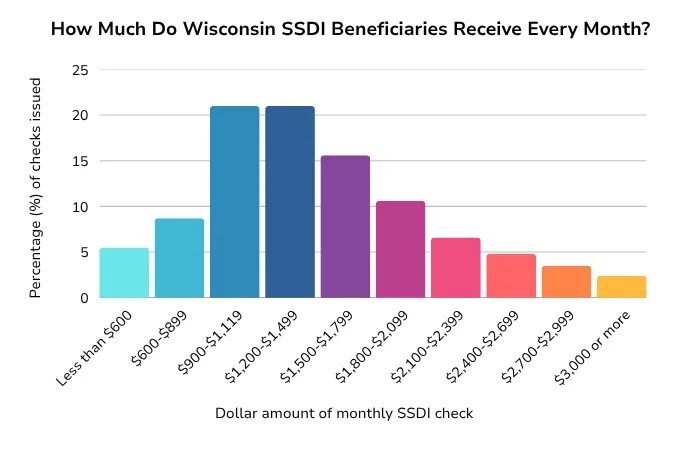
Source: Annual Statistical Report on the Social Security Disability Insurance Program, 2023
SSI payments are set annually by the federal government at a flat monthly rate ($967 in 2025) that’s decreased if you have additional income. Wisconsin residents who are approved for SSI benefits can also receive a small state supplemental payment in addition to the monthly federal SSI payments. For 2025, this supplement is $83.78 for individuals ($132.05 for couples) living independently or in another’s household. Wisconsinites who live in a nursing home can get a state supplement of $179.77 ($477.41 for couples).
Wisconsin Vocational Rehabilitation Services
Disabled residents who want to return to work can contact the Wisconsin Department of Workforce Development (DWD) for assistance. The DWD offers vocational rehabilitation services that include job training, employment counseling, and help obtaining disability-related accommodations. There are numerous DWD and job center locations located throughout Wisconsin. You can find more information on their website at www.dwd.wisconsin.gov/dvr.
How Can I Get Help with My SSDI or SSI Claim?
The laws, rules, and procedures that apply to Social Security disability determinations can be difficult for claimants to navigate on their own. Many applicants choose to hire experienced disability attorneys, especially if they've been denied benefits already. If you need to appeal a denial, it usually makes sense to talk to a disability lawyer who can help strengthen your claim and increase your chances of winning.
If you’re worried about the cost of hiring a lawyer—as many disability claimants are— it may help to know that disability attorneys typically work on contingency, meaning they don’t get paid unless and until you win your claim. Many also offer free consultations, so it doesn’t hurt to ask around until you find a lawyer who’s a good fit for you.

In This Article
- How to File for Social Security Disability in Wisconsin
- Should I File for SSDI or SSI?
- Who Makes Disability Determinations in Wisconsin?
- Medical Conditions That Qualify for Disability
- What Are My Chances of Getting Approved for Benefits in Wisconsin?
- Appealing a Denial to a Disability Hearing Office
- How Much Is Disability in Wisconsin?
- Wisconsin Vocational Rehabilitation Services
- How Can I Get Help with My SSDI or SSI Claim?