
Learn what your chances of winning a disability claim in Virginia are, what to do if you're denied, and who to contact for an appeal.
Written and Edited by Lawyers
All articles on DisabilitySecrets.com have been written or edited and fact-checked by our in-house attorney editors, who together have over 35 years of experience practicing and covering disability law. Learn more about our team and our editorial standards.
Virginia residents who have a medical impairment that keeps them from working full-time may qualify for Social Security Disability Insurance (SSDI) or Supplemental Security Income (SSI), the two federal benefit programs that offer assistance to disabled people. According to the Social Security Administration, about 189,936 of Virginia residents aged 18-64 receive SSDI, or about 3.2% of the state’s population, while 88,794 Virginians (about 1%) receive SSI.
As federal programs, many aspects of the SSDI and SSI application process are uniform throughout the United States. However, waiting times, approval statistics, and availability of supplemental benefits vary between the states. Knowing how Virginia claims examiners and disability judges handle your application can help you increase your chances of getting benefits (and make the waiting game more tolerable).
In This Article
- How to File for Social Security Disability in Virginia
- Should I Apply for SSDI or SSI?
- What Conditions Qualify for Disability in Virginia?
- Who Makes the Disability Determinations in Virginia?
- Hearing Offices for Virginia Disability Appeals
- Virginia Disability Approval Rates
- How Much is Disability in Virginia?
- Short-Term Disability and Vocational Rehab in Virginia
- How Can I Get Help with My SSDI or SSI Claim?
How to File for Social Security Disability in Virginia
The Social Security disability application process is fairly straightforward. You can choose from three different methods when filing for SSDI or SSI benefits:
- Use Social Security’s convenient online application tool. (Before you start, you may first want to read our article with tips for applying online.)
- Call the national hotline at (800) 772-1213 from 8 a.m. to 7 p.m., Monday through Friday, to speak with a representative. If you’re deaf or hard of hearing, you can use the TTY number at 800-325-0778.
- Visit your local Social Security field office to complete a paper disability application. There are about 30 field offices located throughout Virginia.
For more details—including what personal information you should have on hand when you apply—check out our article on filing a disability claim with Social Security.
Should I Apply for SSDI or SSI?
SSDI and SSI—also referred to as Title II and Title XVI—are the two types of disability benefits provided by Social Security. Although the agency’s definition of disability is the same for both programs, each benefit has its own preliminary eligibility criteria (“non-medical qualifications”) that you must satisfy in order to legally receive payment.
For SSDI, this means having enough work credits to be insured under the program on the date you became disabled. (Work credits are earned by paying into the program through payroll or self-employment taxes.) SSI, on the other hand, is a needs-based benefit available to people with limited income and resources, regardless of work history. You can file for both programs and let Social Security figure out which ones you qualify for, but you must be financially eligible to receive at least one of the two benefits. Otherwise, your application will be denied.
What Conditions Qualify for Disability in Virginia?
Any severe impairment may qualify you for disability benefits, provided that you have enough medical evidence to show that you either meet a listing or are unable to work at any job. In Virginia, some of the most commonly awarded impairments are mental illnesses (such as anxiety or depression), musculoskeletal conditions (like back pain), and nervous system disorders (for example, diabetic neuropathy).
The chart below illustrates the percentage of SSDI recipients in Virginia who were found disabled based on the most commonly awarded medical conditions.
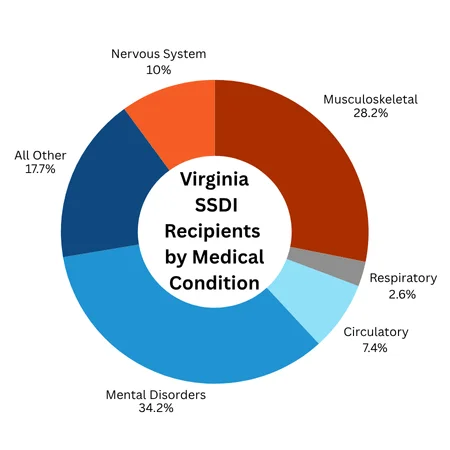
Source: Annual Statistical Report on the Social Security Disability Insurance Program, 2023
For more information, check out our article on what conditions qualify for Social Security disability benefits.
Who Makes the Disability Determinations in Virginia?
After your Social Security field office gets your application, they’ll first make sure that you meet the technical qualifications to receive benefits. Your file is then passed on to a claims examiner at the Virginia Disability Determination Services (DDS), who reviews your records with help from a medical consultant and decides whether you’re disabled.
DDS reviews claims at both the initial stage and on reconsideration (the first level of appeal). In recent years, the average time it takes for examiners at Virginia DDS to make an initial disability determination is 172.2 days, or about five and a half months. (Source: Staffing, Productivity, and Processing Times at State Disability Determination Services, July 2025.) Reconsideration review takes a bit longer, averaging 213 days (around 7 months).
There are six DDS offices throughout the state of Virginia. If you need to submit additional medical records while your claim is being worked on at DDS, you should send them to the office handling your case. You can find the contact information for each office below.
|
Central Administrative Office |
Central District Office |
|
Tidewater District Office |
Northern District Office |
|
Southwest District Office |
Extended Service Team District Office |
To speak to a DDS representative, call 855-445-3938. You can also speak directly to the disability examiner assigned to your file using the contact information that can be located at the bottom of any letter you’ve received from DDS. (If you leave a voicemail, allow two business days for the examiner to return your call.) Keep in mind that examiners need permission from the person applying for benefits to discuss claim specifics with anyone other than the applicant.
Hearing Offices for Virginia Disability Appeals
If you’ve been denied after reconsideration at DDS and you wish to continue with your claim, you have 60 days to appeal by requesting a disability hearing. Once you’ve submitted your hearing request, your file is transferred from Virginia’s DDS over to one of the six Social Security Office of Hearings Operations (OHO) locations that serve the state.
Staff at each OHO schedules and conducts the hearings for claims coming from the field offices in its geographical region. Four of the OHOs are located in Virginia, with one in D.C. and one in Morgantown, WV. Once you've requested a hearing, direct all of your questions to the OHO handling your case. (The average wait time between when you request your hearing and when the hearing is held is about 8 months.) You can find the contact information for the OHOs below.
| Charlottesville OHO 2nd Floor 1470 Pantops Mountain Place Charlottesville, VA 22911 Telephone: 866-613-2969 Services the following field offices: Charlottesville, Culpeper, Danville, Harrisonburg, Martinsville, South Boston, and Staunton |
Norfolk OHO 3rd Floor 5850 Lake Herbert Drive Norfolk, VA 23502 Telephone: 866-931-9167 Services the following field offices: Accomac, Hampton, Newport News, Norfolk, Portsmouth, Suffolk, and Virginia Beach |
| Richmond OHO Suite 225 1100 E. Main Street Richmond, VA 23219 Telephone: 877-405-3665 Services the following field offices: Chesterfield, Farmville, Fredericksburg, Lynchburg, Petersburg, and both Richmond field offices |
Roanoke OHO Second Floor, Suite 200 612 South Jefferson Street Roanoke, VA 24011 Telephone: 866-592-3548 Services the following field offices: Bristol, Covington, Roanoke, Wise, and Wytheville |
| Washington, D.C. OHO 3rd Floor 1227 25th Street N.W. Washington, DC 20037 Telephone: 866-414-6259 Services the following field offices in Virginia: Alexandria, Arlington, Fairfax, and Manassas |
Morgantown, WV OHO Suite FS1 5000 Greenbag Road Morgantown, WV 26501-7236 Telephone: 877-405-9197 Services the following field offices in Virginia: Clarksburg, Elkins, Fairmont, Morgantown, and Wheeling |
Virginia Disability Approval Rates
Statistically, claims examiners at Virginia DDS approved 43.7% of disability applications at the initial level, above the national average of 38.3%. The approval rate after reconsideration review is 19.2%—again higher than the national average of 15.9%. At the hearing stage, for the fiscal year ending July 2025, administrative law judges in offices handling Virginia disability claims issued decisions on 8,709 disability claims. 4,639 of those decisions resulted in either fully or partially favorable outcomes, for an approval rate of about 53%.
How Much is Disability in Virginia?
Because SSDI and SSI are federal benefits, the amount you’ll receive doesn’t change from state to state. SSDI payments are particularly tailored to each beneficiary since they’re calculated based on your individual earnings record, which can vary significantly between each person. Below is a chart showing the distribution of SSDI benefit amounts for Virginia residents:

Source: Annual Statistical Report on the Social Security Disability Insurance Program, 2023
SSI payments are set annually by the federal government at a flat monthly rate ($967 in 2025) that’s decreased if you have additional income. Virginia adds a supplemental payment to beneficiaries in assisted living facilities and adult foster care. Called an "auxiliary grant," the supplement is administered by the Virginia Department of Social Services. The amount of the auxiliary grant—which can only be used to pay for assisted living or adult foster care—varies by county. (Each beneficiary, no matter where you live, will get an $87 monthly personal needs allowance.)
Virginia has divided the state into two areas for the purpose of supplemental SSI payments: "Planning District 8" and all other areas. Planning District 8 includes the counties of Arlington, Loudoun, Prince William, Fairfax, Falls Church, Manassas, Manassas Park, and the city of Alexandria. In 2025, if you reside in an assisted living facility within Planning District 8 and you receive SSI, your auxiliary grant will be $2,418 per month. For all other locations, your grant will be $2,103 per month.
Short-Term Disability and Vocational Rehab in Virginia
Social Security doesn’t award disability benefits for health conditions that last for less than one year. So if you’re expecting to return to work within the year and you have private short-term disability insurance, you might consider filing a claim with your insurer instead. Most employer-provided short-term disability will pay you a certain percentage of your average wages for a time (typically weeks or months) due to an illness or injury you incurred off the job. For more information, check out our article on preparing and filing your short-term disability claim.
If you’re coming off of short-term disability benefits and need help readjusting to employment or you’re on Social Security benefits and want to re-enter the workforce, Virginia offers vocational rehabilitation services through its Department for Aging and Rehabilitative Services (DARS). DARS assists disabled individuals with training, job placement and life skills. To apply for vocational services, you can call or email your local DARS office.
How Can I Get Help with My SSDI or SSI Claim?
The laws, rules, and procedures that apply to Social Security disability determinations can be difficult for claimants to navigate on their own. Many applicants choose to hire experienced disability attorneys, especially if they've been denied benefits already. If you need to appeal a denial, it usually makes sense to talk to a disability lawyer who can help strengthen your claim and increase your chances of winning,
If you’re worried about the cost of hiring a lawyer—as many disability claimants are— it may help to know that disability attorneys typically work on contingency, meaning they don’t get paid unless and until you win your claim. Many also offer free consultations, so it doesn’t hurt to ask around until you find a lawyer who’s a good fit for you.

In This Article
- How to File for Social Security Disability in Virginia
- Should I Apply for SSDI or SSI?
- What Conditions Qualify for Disability in Virginia?
- Who Makes the Disability Determinations in Virginia?
- Hearing Offices for Virginia Disability Appeals
- Virginia Disability Approval Rates
- How Much is Disability in Virginia?
- Short-Term Disability and Vocational Rehab in Virginia
- How Can I Get Help with My SSDI or SSI Claim?