
Discover important information about Tennessee disability claims, including approval ratings and wait times.
Written and Edited by Lawyers
All articles on DisabilitySecrets.com have been written or edited and fact-checked by our in-house attorney editors, who together have over 35 years of experience practicing and covering disability law. Learn more about our team and our editorial standards.
Tennessee residents who have a medical condition that keeps them from being able to work full-time for at least twelve months can file for Social Security Disability Insurance (SSDI) or Supplemental Security Income (SSI). According to the most recent Social Security data, about 289,661 of Tennessee adults aged 18-64 receive SSDI or SSI benefits, or 6.7% of the state’s population.
While SSDI and SSI benefits are federally funded—and the application procedures are the same across the country—each state has its own agency that helps process disability claims at the initial stage. This results in regional differences in approval ratings and waiting times for a decision. Knowing how to navigate the application and appeals process in Tennessee can greatly increase your chances of a successful claim.
In This Article
- How to File for Disability Benefits in Tennessee
- Which Disability Program Should I Apply For?
- How Do I Qualify for Disability in Tennessee?
- What Medical Conditions Qualify for Disability in Tennessee?
- How Do I Appeal if My Initial Application Has Been Denied?
- How Much is SSDI or SSI in Tennessee?
- Tennessee Vocational Rehabilitation Services
- Finding a Tennessee Disability Lawyer
How to File for Disability Benefits in Tennessee
Applying for SSDI or SSI is a fairly straightforward process. There are several ways you can begin your claim for Social Security disability benefits:
- Use the application tool provided on Social Security’s secure website. (Before you start, you may first want to read our article with tips for applying online.)
- Call Social Security’s national number at 800-772-1213 from 8:00 a.m. to 7:00 p.m., Monday through Friday, to speak with a representative. If you’re deaf or hard of hearing, you can use the TTY number at 800-325-0778.
- File in person at one of the over two dozen Social Security field offices in Tennessee. Offices are typically open weekdays from 9 a.m. to 4 p.m., but you may need to make an appointment.
The chart below provides contact information for Tennessee’s field offices.
|
Athens Office |
Chattanooga Office |
|
Clarksville Office |
Cleveland Office |
|
Columbia Office |
Cookeville Office |
|
Dyersburg Office |
Gallatin Office |
|
Greenville Office |
Jacksboro (La Follette) Office |
|
Jackson Office |
Johnson City Office |
|
Kingsport Office |
Knoxville Office |
|
Lawrenceburg Office |
Madison Office |
|
McMinnville Office |
Memphis Downtown Office |
|
Memphis North Office |
Memphis South Office |
|
Morristown Office |
Murfreesboro Office |
|
Nashville Office |
Oak Ridge Office |
|
Paris Office |
Selmer Office |
|
Tullahoma Office |
Union City Office |
For more comprehensive details, including what personal information you should have on hand when you apply, check out our article on filing a disability claim with Social Security.
Which Disability Program Should I Apply For?
SSDI and SSI—also referred to as Title II and Title XVI—are the two types of disability benefits provided by Social Security. Although the agency’s definition of disability is the same for both programs, each benefit has its own preliminary eligibility criteria (“technical qualifications”) that you must satisfy in order to legally receive payment.
For SSDI, this means having enough work credits to be insured under the program on the date you became disabled. (Work credits are earned by paying into the program through payroll or self-employment taxes.) SSI, on the other hand, is a needs-based benefit available to people with limited income and resources, regardless of work history. You can file for both programs and let Social Security figure out which ones you qualify for, but you must be financially eligible to receive at least one of the two benefits.
How Do I Qualify for Disability in Tennessee?
The Social Security Administration awards disability benefits to people who have a medically determinable impairment that prevents them from working at or above the level of substantial gainful activity for one year or more. You must also meet the technical qualifications to receive either SSDI or SSI. If you’re “overresourced” for SSI and you don’t have enough work credits to get SSDI, you can’t receive any benefits no matter how severe your medical condition is.
Any severe impairment may qualify you for disability benefits, provided that you have enough medical evidence to show that you either meet a listing or are unable to work at any job. While the exact type of evidence will vary depending on your specific condition, it’s key to have documentation of regular doctor’s visits, objective imaging such as X-rays or MRIs, and reports from physical or mental evaluations conducted by your medical providers.
What Medical Conditions Qualify for Disability in Tennessee?
The chart below illustrates the percentage of SSDI recipients in Tennessee who were found disabled based on the most commonly awarded medical conditions:
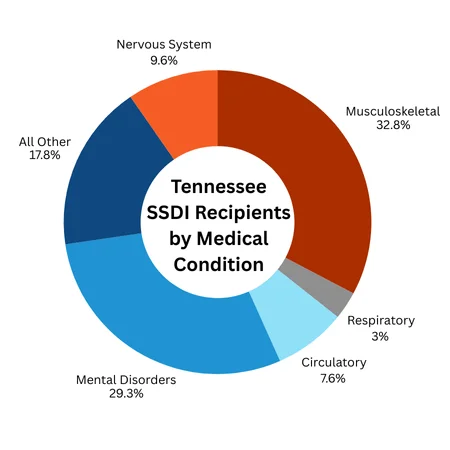
Source: Annual Statistical Report on the Social Security Disability Insurance Program, 2023
Regardless of your diagnosis, you’ll need to submit medical records from your doctors. Tennessee law limits how much non-hospital medical providers can charge you if you need the records to appeal a Social Security disability denial, meaning your doctor’s office can’t make you pay more than $20 for electronic copies of your records. (Tenn. Code 63-2-102 (2024))
How Do I Appeal if My Initial Application Has Been Denied?
After you've submitted your application, Social Security will make sure that you meet the technical qualifications for receiving benefits. Your file is then passed on to Disability Determination Services, or "DDS," the state agency tasked with processing disability claims in Tennessee. There, a claims examiner—with help from a medical consultant—reviews your records and determines whether you're disabled. About 33.7% of disability claims in Tennessee were approved at the initial application stage—less than the national average of 38%—and 13.7% were approved following reconsideration review, below the national average of 15.9%. That means most Tennessee residents will need to appeal a denial at least once in order to get a hearing with a disability judge (where they have the best chances of approval).
There are four total levels of appeal for Social Security denials: reconsideration, disability hearing, Appeals Council review, and filing a lawsuit in federal court. At each stage, you have 60 days from the date you received your denial letter to appeal. (Make sure to stay on top of the appeal deadline—if you don’t have good cause for missing it, you’ll have to start the process over from the beginning.)
- Reconsideration. If your initial application for disability is denied, you can ask that the DDS reconsider its decision. Then, a new claims examiner at DDS (not the one who made the original denial) will look at your case.
- Hearing. If you’re denied following reconsideration review, you have the opportunity to request a hearing with an administrative law judge (ALJ). During the hearing, the ALJ will ask you questions about your medical conditions and why you can’t work.
- Appeals Council. If, after the hearing, the ALJ issues an unfavorable decision, you can ask the Appeals Council to review the decision for reversible error (legal mistakes). If the ALJ made a reversible error, the Council may return your case to the ALJ with instructions to reconsider certain evidence.
- Federal court. If the Appeals Council denies your claim, you can take your case to the federal district court. There are district courts in Tennessee for the Eastern District, the Western District, and the Middle District.
The hearing level is where most Tennesseans are awarded disability benefits. At this level, your claim passes from Tennessee DDS examiners to Social Security’s Office of Hearings Operations (OHO), where your case will be assigned to a judge at one of the six OHO branches serving Tennessee. Staff at the appropriate OHO will schedule your hearing, and—depending on your manner of appearance—you may have to be physically present at the office on the date and time printed on your hearing notice. You can find contact information for each OHO below.
|
Chattanooga OHO Phone: (877) 833-2721 Areas Serviced: Athens, Chattanooga, Cleveland, and Tullahoma |
Franklin OHO Phone: (866) 568-9450 Areas Serviced: Columbia, Jackson, Lawrenceburg, McMinnville, Murfreesboro, and Selmer |
|
Kingsport OHO Phone: (888) 632-6913 Areas Serviced: Greenville, Kingsport, Johnson City, and Morristown |
Knoxville OHO Phone: (877) 692-3141 Areas Serviced: Cookeville, Jacksboro, Knoxville, and Oak Ridge |
|
Memphis OHO Phone: (866) 348-5830 Areas Serviced: Dyersburg, Memphis, and Union City |
Nashville OHO Phone: (877) 583-4103 Areas Serviced: Clarksville, Gallatin, Madison, Nashville, and Paris |
As of August 2025, the average wait time in Tennessee from your hearing request date to when the hearing is held is 7 months. For the fiscal year ending July 2025, judges in OHOs across Tennessee issued 10,750 decisions on disability claims. 6,216 of those decisions resulted in either fully or partially favorable outcomes, resulting in an approval rate of about 57%.
How Much is SSDI or SSI in Tennessee?
Because SSDI and SSI are federal benefits, the amount you’ll receive doesn’t change from state to state. SSDI payments are particularly tailored to each beneficiary since they’re calculated based on your individual earnings record, which can vary significantly between each person. The chart below shows the distribution of SSDI payments for beneficiaries in Tennessee:
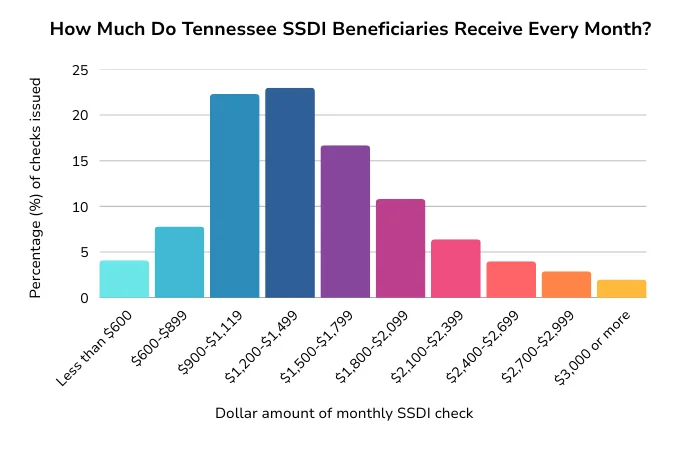
Source: Annual Statistical Report on the Social Security Disability Insurance Program, 2023
SSI benefits are set at the federal benefit rate ($967 per month, in 2025) minus any countable income you have for that month. While many states provide a modest supplemental benefit in addition to the federal rate, Tennessee doesn’t currently provide extra cash payments to SSI recipients.
Tennessee Vocational Rehabilitation Services
Tennessee offers vocational rehabilitation programs through the state’s Department of Human Services. These programs include training, job counseling, help with resume writing, and individualized guidance tailored to help disabled residents of Tennessee return to work. You can inquire about vocational rehabilitation (for yourself or for another) by completing the official online referral form.
Finding a Tennessee Disability Lawyer
You aren’t obligated to hire an attorney at any stage of the disability determination process, but it’s generally a good idea. Your chances of winning are much higher if you're represented by an experienced lawyer. And while disability attorneys can be licensed in any state in order to represent you for your Social Security claim, it can be beneficial to have a local lawyer who is familiar with Tennessee’s DDS claims timeline and the judges at the hearing offices in the state.
Disability attorneys typically work on contingency—meaning they don’t get paid unless (and until) you win your case—so there’s little upfront cost to hiring one. Many offer free consultations, so it doesn’t hurt to ask around until you find a lawyer who’s a good fit for you.

In This Article
- How to File for Disability Benefits in Tennessee
- Which Disability Program Should I Apply For?
- How Do I Qualify for Disability in Tennessee?
- What Medical Conditions Qualify for Disability in Tennessee?
- How Do I Appeal if My Initial Application Has Been Denied?
- How Much is SSDI or SSI in Tennessee?
- Tennessee Vocational Rehabilitation Services
- Finding a Tennessee Disability Lawyer