
Social Security disability needs timely, accurate, and sufficient medical evidence. Here's what that means.
Written and Edited by Lawyers
All articles on DisabilitySecrets.com have been written or edited and fact-checked by our in-house attorney editors, who together have over 35 years of experience practicing and covering disability law. Learn more about our team and our editorial standards.
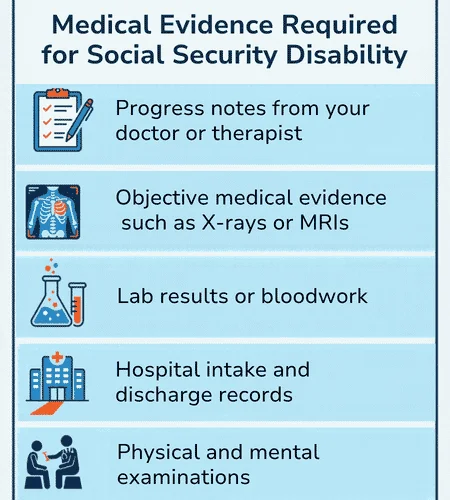
Medical evidence is the backbone of your Social Security disability (SSDI or SSI) claim, consisting of progress notes from your doctors, objective medical imaging (like X-rays, CT scans, or MRIs), lab results, and findings from physical or mental examinations. Without medical evidence, Social Security can’t perform key evaluations essential to determining if you’re disabled, such as whether you have a severe impairment that meets a Blue Book listing or makes you unable to work at any full-time job.
Having timely, accurate, and sufficient records from your regular medical providers is the best way to strengthen your disability claim. (It also reduces the likelihood that Social Security will have to obtain additional records, which can speed up how quickly the agency makes a decision.) Before you apply for SSDI or SSI, it’s a good idea to understand what evidence Social Security needs to see in order to approve a claim for benefits and what you can do to obtain these records.
In This Article
- What Type of Medical Evidence Do I Need for Disability?
- What Other Medical Evidence Is Relevant for Disability?
- How Far Back Does Social Security Look at Medical Records?
- Are There Types of Records That Aren’t Helpful to My Claim?
- Which Medical Records Are Most Helpful for Disability Claims?
- What Happens If I Don’t Have Enough Records or the Right Kind of Medical Evidence?
What Type of Medical Evidence Do I Need for Disability?
The Social Security Administration (SSA) wants to see information in your medical records that's timely, accurate, and sufficient. Here's what this means.
Timely Records
Timely records are recent enough to be relevant to your current medical condition. How recent is a matter of medical judgment, depending on the disorder.A condition that's rapidly changing requires more up-to-date information than one that is slowly progressive or unchanged for years.
Generally, the SSA wants to see medical records for your most recent three to four months of treatment. If your last records are six months old, that’s pushing it, but may be acceptable depending on the claims examiner or administrative law judge reviewing your case. Ideally, the agency will have access to your most recent available medical records, although that’s not always possible given lag times in requesting, copying, and submitting medical information.
Accurate Records
Accurate records correctly describe your condition according to the standards of acceptable medical sources. Acceptable medical sources are medical doctors, osteopaths, physician assistants, nurse practitioners, and, in some cases, licensed psychologists, audiologists, optometrists, speech pathologists, and podiatrists.
To use a common example, your chiropractor can describe subluxation (slippage) of your spine on X-rays, but Social Security won't take this opinion as accurate if a medical doctor (M.D.) or other acceptable medical source reports that your X-rays are normal.
The SSA doesn't consider a chiropractor's records and notes as evidence of an impairment because chiropractors aren't medical doctors. But X-rays taken by a chiropractor or their findings on physical examination—such as reduced range of motion—can be admissible as evidence.
Also, if the SSA has objective evidence that conflicts with your doctor's medical opinion, the agency may not consider that opinion to be accurate. For instance, if your doctor’s records say that you can’t walk one block because of chest pain, but you've had specific exercise testing that shows that you can do much more exercise, Social Security is likely to reject your doctor's opinion.
Sufficient Medical Records
Sufficient medical records contain enough accurate information from acceptable medical sources to allow Social Security to make an independent medical judgment on how severe your medical condition is. For example, having a doctor's note with a diagnosis of cancer isn't sufficient. The SSA needs proof of your disability. The agency wants to know:
- Did a biopsy prove the cancer’s presence?
- What is the exact type of cancer?
- Where in the body is the cancer?
- When did symptoms first appear?
- What did a physical examination show?
- What did X-rays and other imaging tests show?
- What did blood tests show?
- Did you have surgery?
- Did the surgery remove all of the cancer?
- Did you have chemotherapy?
- What side effects did you suffer from the chemo, if any?
- Did you have radiation therapy?
- What were the results of the radiation therapy?
(Read more about the medical evidence required for disability based on cancer. Similarly, the evidence requirements for HIV-AIDS disability are specific and involved.)
What Other Medical Evidence Is Relevant for Disability?
Social Security needs to see evidence showing the ways in which your particular condition causes functional limitations in your activities of daily living. These limitations can be physical, mental, or both.
How to Find the Medical Evidence Required for Your Condition
The SSA maintains a listing of impairments (the “Blue Book”) that are considered especially severe. Medical conditions that are in the Blue Book are potentially automatically disabling, provided that your records contain the specific information laid out in each listing. You should review the Blue Book to see whether your medical condition is considered a listed impairment. If it is, then the listing will tell you what you need to have in order to get disability automatically.
Even if you don’t meet the requirements of a listing, however, the listing should give you a sense of what medical evidence the SSA wants to see in your file—for example, blood work that shows a decrease in liver enzymes if you have cirrhosis or a mental evaluation showing significant difficulties with memory. You can then obtain these records and use them to argue that your residual functional capacity rules out all work.
Details About Your Symptoms and How They Affect Your Daily Activities
Social Security will also consider the effects of your symptoms and how they limit you, so your medical records should include evidence of the following:
- your daily activities (what you can and can't do, using specific examples)
- the location, duration, frequency, and intensity of your pain or other symptoms
- precipitating factors (things that cause or trigger symptoms)
- exacerbating factors (things that make your symptoms worse)
- the type of medication you’re taking, including the dosage, whether or not the medication helps your symptoms, and whether you experience any side effects
- anything else that you do to relieve pain or other symptoms, and
- any other factors about your symptoms that limit your ability to function.
Ideally, your doctor will mention these issues when writing their progress notes, so don’t forget to bring them up at your appointments.
Longitudinal Medical Evidence
While timely records are important in establishing that you’re disabled now, older records that can show that you were disabled some time in the past, even if they’re from several years ago, shouldn’t be neglected. The SSA would like to see "longitudinal" records—that is, records that include your medical history over a number of months or years, especially if you hope to get past-due benefits.
For example, say you were sick for six months before you applied for disability and were unable to work during that time. You could be eligible for a retroactive award of benefits for the six months you couldn’t work. But if your doctor (or a past clinic or hospital you visited) doesn't have detailed medical records for the entire time period you were sick, you might not be able to prove you were unable to work during those six months.
How Far Back Does Social Security Look at Medical Records?
Social Security will generally consider all medical records for your disability claim that are relevant to the medical conditions you claim are disabling. The records should cover the entire period of time you've been disabled. Specifically, the time period starts with your alleged onset date (AOD) and remains ongoing, unless your medical condition got better (in which case you may still be eligible for a closed period of disability).
For example, if you tell Social Security that your onset date is January 1, 2023—meaning you were no longer able to work as of that date—the agency will consider January 1, 2023 to be your AOD. To be found disabled back to the date of your AOD, you must have medical records going back that far. Even if that means the medical records are several years old, Social Security will review them.
Are There Types of Records That Aren’t Helpful to My Claim?
Not all medical records are going to be helpful. Sometimes it’s an issue with the recordkeeping (the SSA can't evaluate medical records that are scribbled and unreadable). Other times, the records don’t contain enough information for Social Security to determine if you’re disabled. Here are some examples.
When records are lacking like this, the SSA will try to obtain data by sending applicants to consultative examinations or to get X-rays and other lab tests.
Which Medical Records Are Most Helpful for Disability Claims?
The best medical records for disability are those from your doctor that are typed, mention all of your complaints, show the results of examinations, note what treatment was given, state your response to treatment, and mention future plans and a prognosis.
The medical records that often carry the most weight with Social Security are medical source statements from your regular doctors. Your treating physician will generally know your medical condition better than any other source. RFC forms are an ideal way for your doctor to let the agency know what your symptoms and limitations are.
What Happens If I Don’t Have Enough Records or the Right Kind of Medical Evidence?
Without enough supportive medical evidence, it will be very hard for you to win your disability claim. Sometimes people don’t have health insurance or are otherwise unable to afford to go see a doctor. While the SSA is sympathetic to the increasingly high costs of health care, the agency is simply unable to award you benefits without medical evidence.
Social Security may ask you if you sought health insurance through the marketplace established by the Affordable Care Act (“Obamacare”) or if you looked for a sliding scale medical provider. The SSA does want to see that you’ve tried all reasonable avenues for getting treatment. (For more information on available resources, see our set of articles about financial support for people with disabilities.)
If you know your medical evidence is lacking, or you want help figuring out what medical evidence you need to prove your disability, consider contacting an experienced disability attorney who can develop the medical evidence that will best help your case. Disability attorneys work on contingency—meaning they don’t get paid unless (and until) you win—and many offer free consultations, so there’s little risk in asking around to find a lawyer who’s a good fit for your case.

In This Article
- What Type of Medical Evidence Do I Need for Disability?
- What Other Medical Evidence Is Relevant for Disability?
- How Far Back Does Social Security Look at Medical Records?
- Are There Types of Records That Aren’t Helpful to My Claim?
- Which Medical Records Are Most Helpful for Disability Claims?
- What Happens If I Don’t Have Enough Records or the Right Kind of Medical Evidence?