You can start to appeal an initial denial by filing a request for reconsideration.
The Social Security disability appeals process has several stages. If you've received a denial after the first time you've submitted your claim—called your initial application—you'll need to request a "reconsideration."
Reconsideration is the first appeal available for disability applicants ("claimants"). In a reconsideration review, a different claims examiner at Disability Determination Services (DDS) reviews your application and medical records to see if the claims examiner who made the original denial decision was correct.
How to Request a Reconsideration
You'll need to file your request for reconsideration within 60 days after the date you receive notice of your initial denial, not the date that's written at the top of your Notice of Disapproved Claim. Don't wait too long after you've gotten the letter to file an appeal, though—the Social Security Administration (SSA) tends to assume that the Postal Service takes around 5 business days to deliver the mail, so the clock starts running pretty close to the date on your denial.
Filing the actual appeal is a simple process that doesn't take much time. One easy method is to submit your appeal online at the Social Security website. The site will ask you to choose between filing a disability ("medical") reconsideration or a technical ("non-medical") reconsideration. If your claim was denied for reasons having to do with your health—for example, DDS didn't think you had any severe impairments—pick "start disability request."
If your claim was denied because you didn't meet the legal or financial requirements of SSDI or SSI, pick "start non-medical request."
If you'd rather file by mail, the forms you need to start your appeal are Request for Reconsideration (Form SSA-561) and Disability Report-Appeal (Form SSA-3441). Click below for samples of these filled-out forms to help guide you.
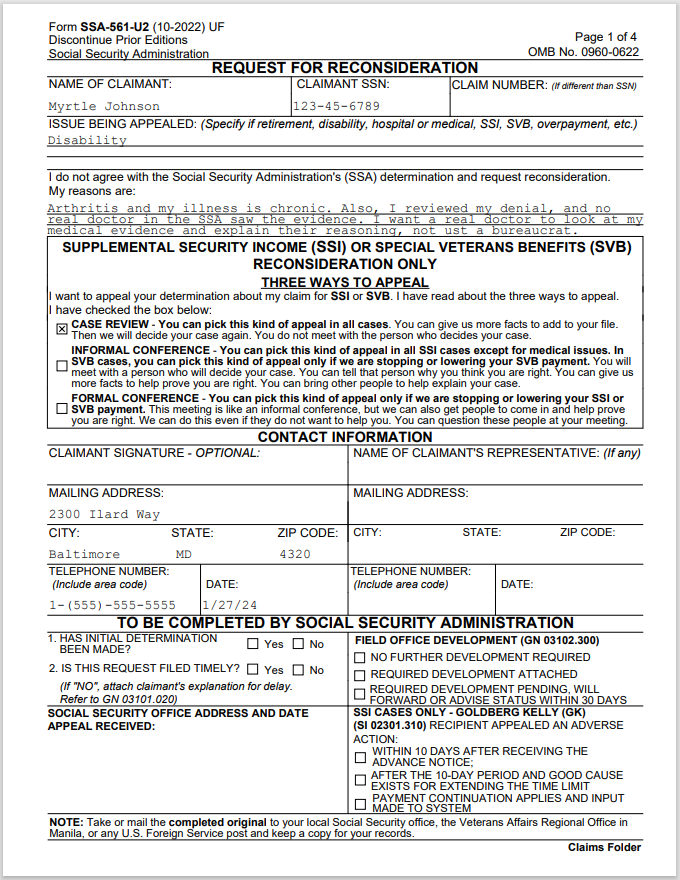
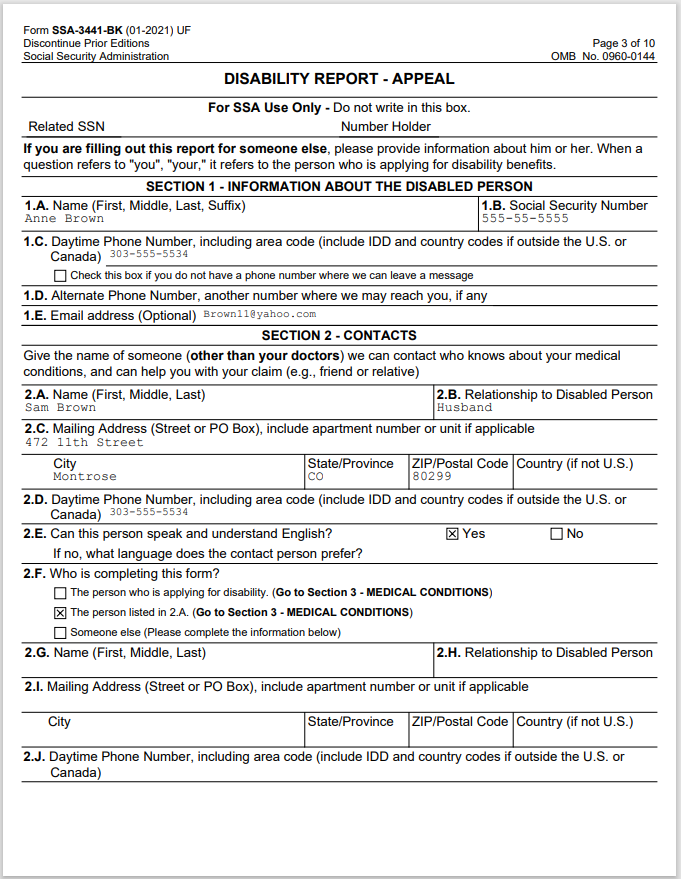
When you've finished, send the completed forms to your local Social Security field office. Make sure you keep a copy of everything that you mail to Social Security.
What to Include With Your Reconsideration Request
If you've been seen by your doctors recently—or started treatment with a new doctor or clinic—make sure to include this information in your reconsideration request.
If you have any new impairments, limitations, or worsening of your conditions, include them as well. You can also add any information that you realized you left out of your initial application at this stage.
The new DDS examiner may request your medical records, but typically your condition will not have changed much (for better or for worse), since the reconsideration review takes place only a few months after the initial decision.
Deadline for Reconsideration Request
Failure to appeal within the 60-day time frame results in an "untimely appeal"—meaning that you'll have to start all over again and file a brand new SSDI or SSI claim for disability benefits.
But you can continue your original appeal if you have "good cause" for missing the deadline. Such exceptions generally include illness, hospitalization, or other circumstances that justify the late filing of an SSDI or SSI disability appeal. Claims representatives are generally pretty tolerant if you filed a reconsideration request late, as long as you have a reasonable explanation why you filed late ("I just forgot" won't cut it).
Chances of Winning a Reconsideration
Very few disability claims are approved at the reconsideration level—in fiscal year 2023, 85% of cases were denied on reconsideration review. Unless you submit new, convincing medical information or your condition has deteriorated, your claim will probably be denied again. But don't give up—you now have the opportunity to request a hearing before an administrative law judge (ALJ), where most winning disability claims are decided.
Requesting an ALJ Hearing
Once your reconsideration appeal has been denied, you have 60 days after you've received the denial to request a disability hearing in front of an ALJ.
The time it takes to schedule an ALJ hearing varies by location, but you can generally expect to wait between 9 to 24 months before you receive a hearing notice in the mail. (Social Security has to give you proper notice when scheduling a hearing, so you should get a Notice of Hearing at least 75 days before the hearing date.)
Because the majority of disability claimants who are awarded benefits win their cases at the hearing level—after receiving denials at the initial and reconsideration stages—this has given rise to a saying that "Social Security denies everybody twice." Statistics do somewhat support this maxim, although it's important to recognize that much depends on an individual claimant's medical records.
One reason that the rate of approval is so much higher at an ALJ hearing is that it takes a year or two to get a hearing scheduled, and during that time, many people's medical conditions get worse.
Learn more about how to prepare for your hearing.
Appeals Council
If you reached the hearing level and still received an unfavorable decision from an ALJ, it's not the end of the line. You can ask the Appeals Council to look at the judge's decision and see if the judge made any "reversible errors," such as misapplication of the grid rules or improperly addressing vocational expert testimony at the hearing.
As with previous steps of the appeals process, you have 60 days to request an Appeal Council review. Once the Appeals Council has received your request for review, they can do one of the following options:
- reverse the judge's decision and directly approve your claim
- send back ("remand") your case to the judge with instructions that another hearing should be held to address errors in the decision
- deny your request for review and allow the judge's decision to stand, or
- dismiss your case.
According to 2020 data from Social Security (the latest available data), most Appeals Council reviews are denied or dismissed, while about 15% are remanded back to the hearing level. Only 1% of cases are directly approved by the Appeals Council.
Federal Court
The Appeals Council is the final level of appeal within the Social Security Administration. If you disagree with an Appeals Council decision, you'll need to file a suit in federal court.
Once again, you have 60 days to appeal to federal court, but for the most part, the rules are different when you're filing in federal court instead of Social Security's administrative appeals process. If you haven't gotten a lawyer yet, now's the time.
How an Attorney Can Help With Social Security Disability Appeals
If you're represented by an attorney who handles SSDI and SSI disability cases, your attorney will start the appeal process for you.
When you hire a disability lawyer, the lawyer will have you complete Form SSA-1696, Claimant's Appointment of a Representative, which allows Social Security to send notices directly to your attorney. Your representative should then contact you with updates on the status of your appeal and respond to any questions you have about the appeals process.
Updated September 26, 2023

Talk to a Disability Lawyer
Need a lawyer? Start here.
How it Works
- Briefly tell us about your case
- Provide your contact information
- Choose attorneys to contact you
Boost Your Chance of Being Approved
Get the Compensation You Deserve
Our experts have helped thousands like you get cash benefits.
How It Works
- Briefly tell us about your case
- Provide your contact information
- Choose attorneys to contact you
Copyright ©2024 MH Sub I, LLC dba Nolo ® Self-help services may not be permitted in all states. The information provided on this site is not legal advice, does not constitute a lawyer referral service, and no attorney-client or confidential relationship is or will be formed by use of the site. The attorney listings on this site are paid attorney advertising. In some states, the information on this website may be considered a lawyer referral service. Please reference the Terms of Use and the Supplemental Terms for specific information related to your state. Your use of this website constitutes acceptance of the Terms of Use, Supplemental Terms, Privacy Policy, Cookie Policy, and Consumer Health Data Notice.
Your Privacy Choices