
Learn how severe your depression must be for you or a loved one to be able to receive Social Security or SSI disability benefits for the condition.
Written and Edited by Lawyers
All articles on DisabilitySecrets.com have been written or edited and fact-checked by our in-house attorney editors, who together have over 35 years of experience practicing and covering disability law. Learn more about our team and our editorial standards.
Depression is one of the most common conditions listed on Social Security disability applications, but approval is far from automatic. Depression, including major depressive disorder and persistent depressive disorder, is a mood disorder marked by persistent sadness, hopelessness, and loss of motivation. People with depression often also suffer from feelings of fatigue and decreased energy levels.

Many people with depression also experience "anhedonia"—the loss of interest in once-enjoyable activities. For those with anhedonia, lack of motivation can be a key limitation in the ability to complete tasks at work.
For Social Security purposes, the key question isn't just whether you have depression, but whether it's severe enough to prevent you from working. This article covers the specific criteria Social Security uses to evaluate depression claims—and what you can do to strengthen yours.
Is Depression a Disability?
Many people suffer from depression associated with emotionally painful situations (the death of a loved one, divorce), but for the most part, these periods of depression are situational and short-lived.
If a person has an episode of depression with severe daily symptoms that last for two weeks or longer, their condition is considered to be clinical depression, or "major depressive disorder" (MDD). Clinical depression interferes with a person’s ability to cope with daily stresses and obligations, often making an individual unable to function effectively in their everyday life, including at work and during family activities.
The Social Security Administration (SSA) requires depression to last much longer than two weeks to qualify as a disability—a disability applicant's major depressive disorder must have lasted or be expected to last at least a year. In addition, your depression must severely limit certain areas of mental functioning, which we'll discuss in detail below, and it must prevent you from working and earning over about $1,700 per month (the "SGA limit").
What Are the Symptoms of Major Depressive Disorder?
Most people with major depressive disorder find that their symptoms sap their ability and desire to take part in daily activities, even those they once most enjoyed. Feelings of fatigue and apathy, an inability to concentrate, constant sadness, irritability, and feelings of guilt or worthlessness, or even thoughts of suicide, are common among depressed individuals.
For many people, clinical depression can be successfully treated with psychotherapy and medication, but until the right combination of therapy or medication is found, this condition can be crippling to some.
Can You Get Disability for Depression or Major Depressive Disorder?
To qualify for SSDI or SSI disability benefits, an individual with depression must either:
- meet certain specific disability criteria found in Social Security's impairment listing manual, or
- qualify for a "medical-vocational allowance" based on the severity of their depression and a combination of other factors (such as other impairments, work history, age, and level of education).
When Does Depression Count as a Disability Under a Listing?
Social Security publishes a list of common, serious illnesses that qualify for disability if they meet the specified criteria. The purpose of the list is to be able to grant disability benefits quickly for severe impairments.
Clinical depression is covered in Social Security's impairment listing 12.04, for "depressive, bipolar and related disorders." The listing includes a set of symptoms and a list of functional problems you must have to qualify for either Social Security disability or SSI disability benefits on the basis of depression.
First, you must show you have severe depression by having at least five of the following symptoms:
- depressed mood
- decreased interest in almost all activities
- appetite disturbance (poor appetite or overeating) resulting in a change in weight
- sleep disturbance (insomnia or oversleeping)
- difficulty concentrating or thinking
- feelings of worthlessness or guilt
- thoughts of death or suicide, and/or
- a slowing of physical movement and reactions, including speech, or increased physical agitation, such as hand wringing or pacing.
In addition to having at least five of the above symptoms, you must also meet "functional" criteria to show that you have a loss of abilities due to the mental disorder. Generally, you must have an extreme limitation in at least one of the following areas, or a "marked” limitation in at least two of the following areas:
- understanding, remembering, or applying information
- interacting with others
- concentrating, persisting, or maintaining pace in performing tasks, and/or
- adapting or managing oneself.
Note that "marked" is worse than moderate—you can think of it as seriously limiting. Extreme is less severe than a complete loss of an ability, but worse than marked. For example, somebody with a marked limitation in interacting with others might avoid crowds and go grocery shopping only when few people are around, while somebody with an extreme limitation in the same area could isolate themselves as much as possible by staying at home and having groceries delivered.
What Do Limitations in These Functional Areas Look Like?
Let's discuss what Social Security looks at to decide whether your limitations are severe enough to rise to the level of a disability.
First, a marked limitation in understanding, remembering, and applying information refers to being seriously limited in the abilities to learn, recall, and use information to perform work activities, including in being able to do the following:
- understand and remember instructions and procedures
- follow one- or two-step instructions to perform a task
- identify and solve problems
- recognize a mistake and correct it
- ask and answer questions, and
- use reason and judgment to make work-related decisions.
Second, a marked limitation in interacting with others refers to being seriously limited in the abilities to relate to and work with supervisors, co-workers, and the public, including being able to:
- cooperate with and handle conflicts with others
- ask for help when needed
- initiate or sustain conversation and state your own point of view
- understand and respond to social cues (physical, verbal, and emotional)
- respond to suggestions, criticism, correction, and challenges, and
- keep social interactions free of excessive irritability, sensitivity, argumentativeness, or suspiciousness.
Third, a marked limitation in concentrating, persisting, or maintaining pace refers to being seriously limited in the abilities to focus attention on work activities and to stay on-task at a sustained rate, including the abilities to:
- work at an appropriate and consistent pace
- complete tasks in a timely manner
- ignore or avoid distractions while working
- change activities or work settings without being disruptive
- work close to or with others without interrupting or distracting them
- sustain an ordinary routine and regular attendance at work, and
- work a full day without needing more or longer rest periods than allotted.
Finally, a marked limitation in adapting and managing oneself refers to being seriously limited in the abilities to regulate emotions, control behavior, and maintain well-being in a work setting, including the following abilities:
- respond to demands
- adapt to changes
- manage psychologically based symptoms
- distinguish between acceptable and unacceptable work performance
- set realistic goals
- make plans for yourself independently of others
- maintain personal hygiene and attire appropriate to a work setting, and
- being aware of normal hazards and taking appropriate precautions.
Remember that to meet the standard listing, you must have an extreme limitation in one of the above areas or a marked limitation in two of the above areas.
Social Security's Alternative Listing for Depression
Most applicants who Social Security finds disabled because of depression do have evidence of marked or extreme limitations. But Social Security can find that you're medically disabled without those limitations if you can show that you're only able to function as well as you do because you get a lot of help.
Applicants who've been living in a highly structured or protected situation or undergoing intense therapy can't always show they currently have the functional limitations discussed above, so Social Security provides another way to meet the listing for depression.
Social Security will look for evidence of a support system that you can't function without, such as social workers, group homes, intensive mental health therapy, or family members who make sure that you're taking care of yourself. You must also show that you have little ability to adapt to demands that aren't already part of your daily life or to changes in your environment that would make the stress and demands on you greater.
Can Depression Qualify for Disability Without Meeting the Listing?
Meeting the requirements of the clinical depression listing above isn't the only way to receive an approval for disability (though it is the most common). If Social Security finds that your depression isn't severe enough to meet the listing above, the agency will determine whether you can be approved for benefits by being granted a "medical-vocational allowance." Social Security will look at whether you have trouble with daily living activities and will fill out a mental evaluation form that assesses your mental residual functional capacity (RFC).
To develop your mental RFC, the SSA will consider how your depression symptoms affect your capacity to do any type of unskilled work by evaluating your ability to:
- carry out simple instructions
- make simple work-related decisions
- respond appropriately to supervision and to co-workers, and
- handle changes in routine.
Social Security will then give you a rating of the type of work it thinks you can do (skilled work, semi-skilled work, or unskilled work). The agency will consider any limitations contained in your doctor's medical source statement when determining what kinds of jobs you can do. You can get a blank mental RFC form to give to your doctor. (Click on the thumbnail below to see a sample of a helpful completed RFC form for depression.)
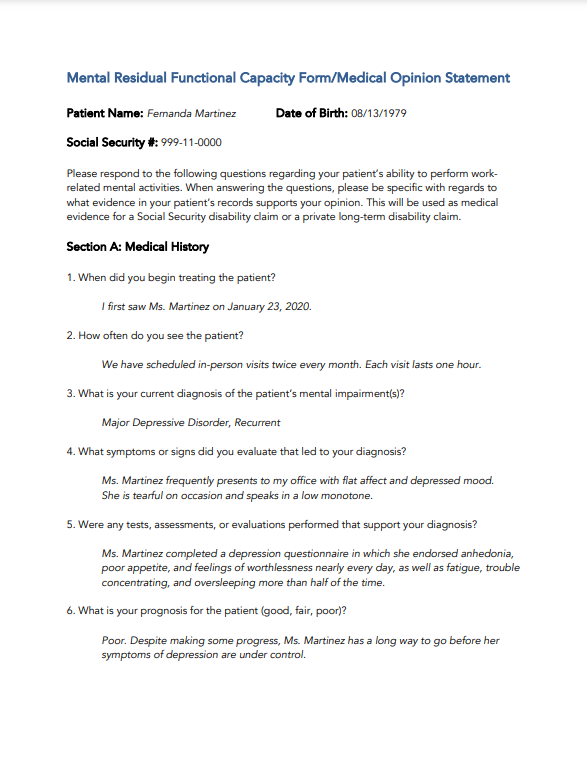
If depression is the only impairment you listed on the disability application, getting disability will be a long shot unless you have severe, disabling depression and can qualify under the listing for depression. But if you have moderate depression and you also have a physical impairment (or another mental impairment) along with depression, you have a better chance of getting benefits than with depression alone.
For instance, if Social Security decides you only have the capacity to perform unskilled work, but you have a physical impairment that requires you do sit-down work, that limits the types of jobs you can do (there aren't too many unskilled jobs that are sedentary). So Social Security might grant you benefits if it decides you aren't qualified to do any sit-down jobs. To understand how Social Security makes these decisions, read more about getting disability benefits based on a medical-vocational allowance for a mental disorder or see our article on how moderate depression affects the disability decision.
How to Apply for Disability Based on Depression
If you're applying for Social Security disability insurance (SSDI), you can file your whole claim online on Social Security's website. Applying online is generally the fastest way to apply for benefits, but you can fill out the application at your own speed.
Most individuals filing for Supplemental Security Income (SSI) only can't file the entire application online, but they can get started on Social Security's website. Children with depression may qualify for SSI as well. You can learn more in our article on getting disability for childhood depression.
If you're not comfortable online, you can call Social Security at 800-772-1213 to start your claim. For more information, see our article on applying for Social Security disability benefits.
If you’d like help with your application, or you just can't get started, think about working with an SSDI lawyer. According to a survey of our readers, applicants who filed an initial application without expert help were denied 80% of the time.
After You Apply for Benefits for MDD
After you submit your application, your state's disability determination services (DDS) agency will assign your claim to a claims examiner for review. If your examiner doesn't find enough evidence of your medical condition in your medical records, you may be required to attend an interview or undergo a consultative mental exam with an SSA-approved psychiatrist or psychologist to verify your condition. Being sent to a mental exam is likely if your file doesn't contain recent mental health records (from the last three or four months or so). (Learn how to prepare for your mental exam.)
The disability process can take several months, but the more evidence and medical documentation you're able to provide, the better your chances are of being able to get your claim approved.
If you receive a denial letter and feel your case is strong enough to win an appeal, consider contacting a disability lawyer. Applicants who go to an appeal hearing represented by a lawyer have a better approval rate than applicants who represent themselves.

In This Article