
Doctors' letters can help you win your Social Security disability case if they contain information about your specific limitations and are supported by medical evidence.
Written and Edited by Lawyers
All articles on DisabilitySecrets.com have been written or edited and fact-checked by our in-house attorney editors, who together have over 35 years of experience practicing and covering disability law. Learn more about our team and our editorial standards.
Medical source statements are written opinions, provided by doctors, that discuss how your health issues result in specific functional limitations. Medical source statements are similar to work restrictions letters that you might use for a worker’s comp claim or requesting reasonable accommodations from your employer, but they have a different purpose—to inform the Social Security Administration (SSA) about any limitations you have that could be considered disabling.
Social Security values medical source statements for the insight they provide into disability claimants’ physical and mental restrictions. Some are “worth” more than others, however, because they come from doctors whom you’ve seen regularly over time and who are familiar with your conditions. Knowing which medical providers to ask for a statement and what that statement should include can greatly increase your chances of a successful disability claim.
In This Article
- Why Are Medical Source Statements Important?
- Will a Medical Source Statement from Your Treating Doctor Get Your Disability Claim Approved?
- How to Make Sure a Medical Source Statement Helps Your Disability Case
- What Does a Helpful Medical Source Statement Look Like?
- Does Social Security Have to Accept My Doctor’s Medical Source Statement?
- Doctor’s Notes for Short-Term Injuries and Illnesses
- What Else Do I Need to Know About Medical Source Statements?
Why Are Medical Source Statements Important?
To determine whether you’re disabled, the SSA looks at your medical records for evidence of any symptoms you have, like back pain or trouble concentrating, that affect your ability to work. But because the claims examiners and administrative law judges who make disability determinations aren’t doctors themselves, they rely on medical source statements to help them make sense of technical language and decide how serious your impairments are.
A typical disability claim contains several medical source statements from doctors who are consultants or contractors for the SSA. Some of these physicians or psychologists evaluate your claim based on a review of the medical records in your file, while others will evaluate your limitations during a consultative examination. But because these doctors only see you once (if at all), their opinions don't often reflect the true extent of your medical conditions.
That’s why the most valuable opinions are from doctors whom you've seen multiple times over the course of a year (or more). In Social Security terms, these opinions are known as "medical source statements from treating doctors." Medical source statements can be especially persuasive to claims examiners and judges—as long as they're not at odds with the rest of the medical records.
Will a Medical Source Statement from Your Treating Doctor Get Your Disability Claim Approved?
Not necessarily. A letter from your doctor isn’t a magic ticket to winning your disability case, especially if it’s just a short sentence stating that you’re disabled. But when a doctor who’s been treating you for a long time provides a detailed description of what your limitations are, with reference to evidence in your medical record that supports their opinion, Social Security is more likely to give that opinion “greater weight”—meaning they’ll agree with your doctor instead of other sources. (20 CFR § 404.1520c.) If your regular doctor thinks you have more restrictions than doctors who’ve only seen you once, the agency will take that into consideration.
The best medical source statements provide specific restrictions that Social Security can incorporate into your residual functional capacity, or RFC. (Your RFC is a paragraph describing what you can and can’t do at work, despite your medical conditions. The agency uses your RFC to determine what kinds of jobs, if any, you can perform.) If your doctor’s statement just says that you’re limited to “light duty,” for example, the agency is less likely to adopt their opinion than if your doctor writes that you can’t stand for longer than 30 minutes.
How to Make Sure a Medical Source Statement Helps Your Disability Case
You’ll first need to decide which doctor to ask for a medical source statement. It's best to choose health care providers—including counselors and therapists—with whom you’ve established an ongoing relationship and will likely support your disability application. You don’t want to put yourself in the position of having to explain to an administrative law judge why your treating physician thinks you can lift 50 pounds or perform complex tasks if you can't.
A brief conversation with your doctors should help you determine whether they will write a useful medical source statement. Depending on the relationship you have with your doctor, you might feel nervous about asking them to do “extra work” for you. The following tips can increase the chances that your doctor will write you a helpful opinion.
Schedule a Time to Talk About Your Disability With Your Doctor
Finding time outside of your regular appointments to talk with your doctor about your disability claim can be a daunting task. Doctors are busy, and you don’t want them to quickly glance at important paperwork. Make sure you have your doctor’s full attention by scheduling an appointment to discuss writing a medical source statement. If you already have an upcoming appointment, consider bringing a sample RFC form so your doctor has a template to work with.
Let Your Doctor Know About Your Limitations
Before your appointment, make a list of all the medical problems—physical and mental—that are keeping you from working. Many people assume that their doctors already know what daily activities they’re struggling with, but what you talk about during a doctor’s visit doesn’t always paint the whole picture. A doctor will likely notice on examination that you have reduced grip strength from carpal tunnel syndrome (for example), but they might not be aware that you struggle to button your shirt or tie your shoes.
Make Sure Your Doctor Has All Relevant Medical Information
If you recently started seeing a new medical provider who hasn’t had the opportunity to review your previous treatment records, you should bring a copy of those records with you when asking for a medical source statement. Opinions based on missing, outdated, or irrelevant information won’t have much sway with Social Security.
Ask Your Doctor If They Support Your Limitations
After reviewing your medical records and discussing your activities of daily living with your doctor, you should have a good sense of whether they’re sympathetic to your disability claim. You can then ask your doctor if they’re willing to write an opinion supporting your limitations. Hopefully, the answer will be “yes.”
If your doctor agrees to write a medical source statement, make sure that the statement includes details about the physical or mental limitations that result from your medical condition. Good medical source statements include:
- the date the doctor began treating you and the frequency of your visits
- references to objective medical evidence (such as an X-ray, MRI, or nerve conduction study)
- specific, quantitative restrictions on what your limitations are (distance you can walk, time you can stand, amount of weight you can lift, number of tasks you can do), and
- reasoning about why the evidence supports the doctor’s opinion on your restrictions.
It’s important to make sure that the medical source statement reflects your doctor’s opinion about what you can and can’t do. While your input is crucial for the doctor to get a better sense of what your restrictions are, most of the value of a doctor’s statement comes from their experience translating medical findings into functional limitations. For example, your doctor should be able to explain why your sciatica prevents you from sitting for longer than one hour or how your depression interferes with your work attendance.
Manage Your Doctor’s Expectations
Some doctors are reluctant to provide an opinion because they think they’ll be asked to testify in court or otherwise get wrapped up in legal proceedings. If that’s the case, you can reassure your doctor that once they’ve completed the medical source statement, they don’t have any additional obligations for your disability claim. But if your doctor seems less than enthusiastic about writing a statement or indicates that they’re opposed to disability benefits in general, seek a different medical opinion.
What Does a Helpful Medical Source Statement Look Like?
Medical source statements are most helpful when they specifically restrict the amount of times you can do certain types of activities and explain why you can’t do them more frequently. The goal is to get the restrictions included in an RFC that is then used to show that you can’t do any full-time work and therefore qualify for disability benefits.
Restrictions can be physical, mental, or both. In your medical source statement, you should make sure that your doctor addresses the following:
- how long (in minutes or hours) you can sit upright at one time
- how long (in minutes or hours) you can sit upright total in an 8-hour workday
- how long (in minutes or hours) you can stand at one time and total in an 8-hour day
- how far (in minutes, hours, feet, miles, or blocks) you can walk before you need to stop
- how much weight (in pounds) you can lift at one time
- how much weight (in pounds) you can carry and for how long (in minutes or feet)
- how often (as a percentage of the workday) you can use your arms to reach overhead, to the side, or to the ground
- how often (as a percentage of the workday) you can use your hands to type, press buttons, or handle small objects
- how often (as a percentage of the workday) you can bend, balance, climb ladders, kneel, and crawl
- how long (as a percentage of the workday) you can maintain concentration on job duties
- how often you should be exposed to fumes, noises, or hazards in the workplace
- how long you can interact with your coworkers, supervisors, and the general public
- whether you need to take extra breaks during the workday and, if so, for how long
- whether you need to lay down, recline, or elevate your legs at work
- whether you can perform simple or complex tasks, and
- how often you’d be absent from work (in days per week or per month).
Ask your doctors to refer to objective evidence that's included in your medical records when writing their statements. For example, if you're applying for disability benefits due to disc degeneration in your lower back, and your doctor's note says that you can't sit for longer than 15 minutes, the note should point to any imaging such as X-rays or MRIs showing how severe the degeneration is.
Sample Medical Source Statements
Most disability attorneys are overjoyed when a client’s doctor provides a comprehensive medical source statement. Below, you can find two examples—one as a written letter, the other as a completed Social Security form—of a helpful doctor's statement for a claimant who is applying for disability benefits due to a musculoskeletal condition (in this instance, knee arthritis).
You can also click on the thumbnail below to see how the above opinion might be provided on Social Security's official Medical Source Statement form for physical impairments.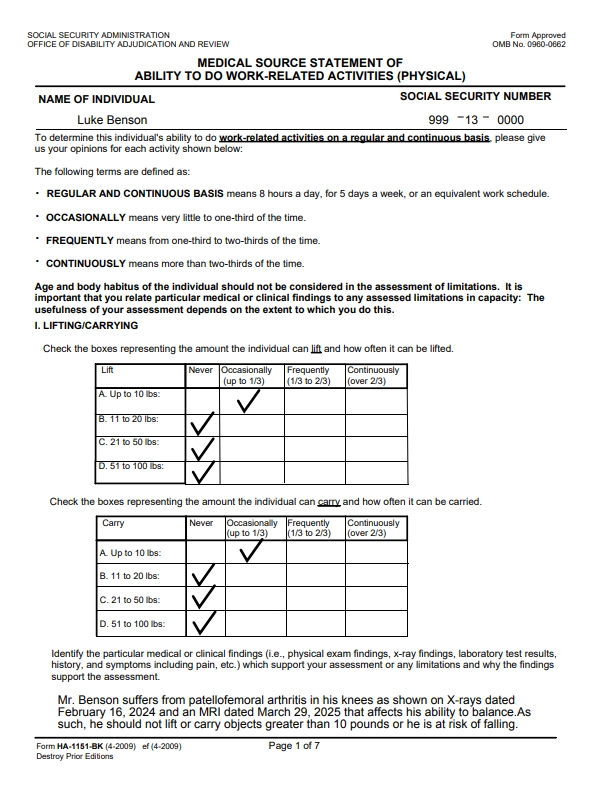
What Your Doctor Should Avoid In the Medical Source Statement
One common mistake made by disability applicants is thinking that a doctor’s note simply stating that you’re disabled is good enough for Social Security—it’s not. The agency considers the ultimate determination of disability to be an “issue reserved to the Commissioner” (the head of the SSA), because the decision involves additional legal factors that aren’t your doctor's area of expertise.
Does Social Security Have to Accept My Doctor’s Medical Source Statement?
Social Security can’t completely ignore your doctor's medical source statement, but the agency will evaluate the opinion in the context of your broader medical records to see if it’s a reasonable interpretation of what’s found within them. Doctors' opinions that are supported by and consistent with the medical evidence as a whole should be accepted, but those that appear to be outliers—such as saying that somebody with paraplegia can walk for miles—tend to be disregarded.
The SSA is more likely to disregard the opinion of your physician if you're missing objective evidence, the opinion conflicts with your doctor’s own clinical notes, or the statement appears to be a “rubber stamp” on self-reported symptoms. For example, if your doctor says that you’re limited to sit-down jobs because of back pain but you haven’t had an X-ray and none of the doctor’s examination notes show evidence of pain (like reduced range of motion or positive straight-leg raising signs), the agency is likely to be skeptical of your doctor’s conclusion.
Even if your doctor's opinion is supported by your medical records, the SSA still might not find that the statement is very persuasive. Factors that disability examiners and judges consider when deciding not to give much weight (legal significance) to your doctor’s opinion may include some of the following:
- You haven’t been seeing the doctor for very long (say, a couple of weeks).
- You've only seen the doctor a few times.
- Your last clinical visit to the doctor was over six months ago.
- The doctor diagnosed your condition, but otherwise isn't that familiar with your case.
- The doctor doesn't have specialized knowledge about your specific impairment.
- Your doctor didn't provide a good reason for why you have certain limitations.
Social Security is required to explain why they gave your doctor's opinion little weight in your disability determination notice. You should be able to find a discussion of these factors either in your personalized disability explanation or in the judge's written decision. If the SSA got something wrong when evaluating your treating relationship with your medical provider, you may be able to correct that on appeal.
Doctor’s Notes for Short-Term Injuries and Illnesses
While comprehensive medical source statements are useful in claims for Social Security benefits, not every injury or illness results in permanent disability. (The SSA doesn’t award disability to people who aren’t expected to be out of work for less than 12 months.) In cases where you need excused absences or you’re filing a claim with your short-term disability insurer, a doctor’s note may be sufficient.
Before paying out benefits, private disability insurers typically need your doctor to provide basic information about your diagnosis, limitations, and how long you’ll be off work. They’re often similar to medical source statements—many insurance providers refer to them as “attending physicians’ statements”—but shorter or in a checkbox format. If you don’t have short-term disability insurance but you’ll be out of work for a while for medical reasons, check with your employer’s human resources (HR) department to see what their policy is on when doctor’s notes are required.
What Else Do I Need to Know About Medical Source Statements?
While medical source statements from treating providers are favored by Social Security, they can be difficult to get even in the best circumstances. You can use the following resources to make the process go more smoothly:
- Learn about the medical evidence Social Security looks for to support your doctor’s opinion.
- Find out when your doctor can charge you a fee to write a medical source statement.
- Discover how to address common concerns doctors have over disability letters.
You might want to consider hiring an experienced disability attorney to help you get your doctor’s opinion into your case file. A lawyer can gather necessary evidence for your doctor to review, follow up with the doctor’s office to make sure that the statement was completed on time, and submit the written opinion to the SSA on your behalf. Disability lawyers don’t get paid unless (and until) you win your claim, so there’s little upfront cost to hiring one.

In This Article
- Why Are Medical Source Statements Important?
- Will a Medical Source Statement from Your Treating Doctor Get Your Disability Claim Approved?
- How to Make Sure a Medical Source Statement Helps Your Disability Case
- What Does a Helpful Medical Source Statement Look Like?
- Does Social Security Have to Accept My Doctor’s Medical Source Statement?
- Doctor’s Notes for Short-Term Injuries and Illnesses
- What Else Do I Need to Know About Medical Source Statements?