You don't have to be disabled for any length of time before you apply for disability benefits, but there is a waiting period to receive SSDI payments.
You don't have to be disabled for any length of time before you apply for Social Security disability insurance (SSDI) or SSI disability benefits. In other words, you can qualify for SSDI or SSI as soon as you stop being able to do a substantial amount of work.
In most cases, the Social Security Administration (also known as "Social Security" or "SSA") defines substantial work as making $1,550 per month (in 2024). (The rules are different for self-employed and blind persons; see our article on substantial gainful work for details.)
How Soon Can I Apply for Disability Benefits?
Contrary to popular belief, you don't have to be off work for six months or a year before you can apply for or collect disability benefits. You can apply for disability as soon as you quit work or are let go because of your medical condition—or when you realize you're disabled and can't go back to work.
But if you haven't been off work for a year, Social Security must expect that your condition will make it impossible for you to work for at least one year. This rule is called the "durational requirement." If Social Security doesn't believe your disability will last a full 12 months, it will send you a "durational denial" letter.
How Does Social Security Know If My Disability Is Long-Term?
How does Social Security know whether you'll be unable to work for at least a year? If you have an abrupt accident or illness that suddenly and obviously makes it impossible for you to work, Social Security will estimate how long your inability to work will last. If your doctor's prognosis is that your illness or impairment will keep you from working for at least a year, and your doctor provides the evidence to back it up, Social Security might grant you disability benefits right away.
For injuries that have caused obvious permanent disability, like a spinal cord injury, Social Security will make a decision on your case right away. But if your prognosis isn't clear, the agency may wait a few months by placing your case on a "medical hold" to see if your condition improves.
How Long Do Medical Holds Last?
When Social Security has information showing that your disability isn't yet stable, and the agency thinks an improvement in your condition might affect your right to benefits, it will place your case on a medical hold (or "deferment").
In these situations, Social Security needs more time to figure out how severe your disability will be, and how long it will last, after a stabilizing period. For many conditions, how long your disability will last is directly related to the treatments that your doctor prescribes and how successful they are. For example, Social Security may place your claim on a medical hold until it receives more information if you recently:
- were diagnosed with a cancer that may respond well to treatment
- had a corrective procedure such as outpatient surgery or a steroid injection
- started a new drug therapy and your response to this treatment is unclear, or
- had an acute health event such as a heart attack or stroke.
In these situations, Social Security will collect more evidence three months following the event, procedure, or treatment and will then evaluate your disability again.
If I Have a Really Severe Condition, Can I Get Benefits Right Away?
There's a difference between getting benefits right away and getting approved right away. If Social Security considers your condition truly severe (for example, amputation of both hands), the agency will approve you after reviewing your initial application, which will take three to four months.
Or, if you have a life-threatening condition that's on Social Security's Compassionate Allowances list, Social Security will make a decision on your claim within a month. Compassionate Allowance conditions are so severe that the claim will always match one of Social Security's disability listings. This means you'll get approved for benefits automatically. Organ transplants, early-onset Alzheimer's, and many late-stage cancers qualify for Compassionate Allowance treatment.
Next is the question of when your benefits will start. If you get approved for SSI for a severe condition, your benefits will begin right after you get your award letter (going back to the first full month after your application date). But if you get approved for SSDI for a severe condition, you have a five-month waiting period where you won't get any benefits. You won't receive SSDI benefits until the sixth full month after your disability started (more on this timeline below).
How Does Working Affect Social Security's Disability Decision?
Working right up until the time you apply for disability can throw doubt on your claim that you can't work (unless you had an abrupt injury or illness that caused you to stop working). If you didn't suddenly become injured or ill, you'll need to provide evidence that you weren't succeeding at working just before you applied for disability (for instance, maybe you had to take a lot of sick days).
How Does Working Affect My Back Pay?
Working up until you apply for disability will affect your disability onset date (the date Social Security says your inability to work began). Unless you can show that your recent work was an "unsuccessful work attempt," your disability onset date can't be until after you stopped working. And the later your disability onset, the less back pay (past due benefits) you'll get. (You can receive benefits retroactively, often back to your onset date, even if you didn't apply right away.)
For example, if you were off work for a while, tried to work again, but had to quit after three months because of the pain, Social Security could treat this as an unsuccessful work attempt. This would let you use the first time you stopped working as your disability onset date, which would mean more backpay for you. (For more information, see our article on the unsuccessful work attempt rules.)
Some disability lawyers actually recommend waiting to apply for disability for a few months after you stop working. But if you have a serious disability and can't work, you should apply for disability as soon as you stop work, since getting disability will take anywhere from three months to three years.
Will I Have a Better Chance of Getting Benefits If I Wait a Year?
No, your chances for approval won't go up if you wait to apply until you've been unable to work for a year. As discussed above, Social Security has procedures it will follow if it's unsure your condition will last a year. If you wait too long, you could lose out on benefits (more on waiting too long next).
Does the SSDI Waiting Period Affect When to Apply?
As mentioned above, the SSDI program does have a five-month waiting period, starting from your onset date of disability, during which you won't receive benefits. ALS (Lou Gehrig's disease) makes for the only exception to this rule; SSDI benefits get paid as soon as they're approved for applicants with ALS.
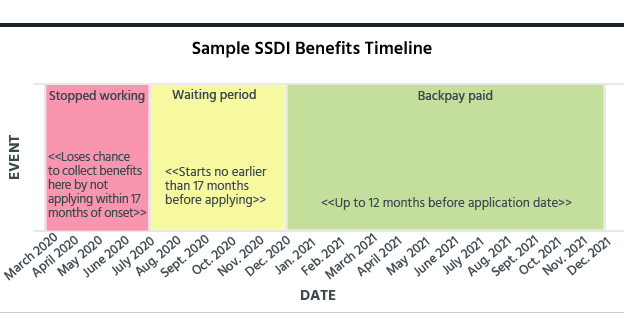
Even if you get approved right after you apply, you'll still have five unpaid months before you get paid benefits, starting from the date Social Security believes you became disabled. But if you apply soon after you become disabled, most of the waiting period will happen during the three or four months (or more) that Social Security takes to review your application. So by the time you get your approval letter, your waiting period might be over.
If you wait too long to apply, you can lose out on some of the back pay you could be eligible for. The date you're eligible to start receiving SSDI benefits (your "entitlement date") can be no earlier than one year before the date you file your application. That means you can get back pay only up to 12 months before the application date. But to get the full 12 months in back payments, your disability must have begun at least 17 months before you apply, due to the five-month waiting period.
When Should I Apply for Disability Benefits?
If you're applying for SSDI, you can start filing your whole claim online on Social Security's website, at any time. On the other hand, most people filing for SSI only can't file the entire application online, though they can get started on Social Security's website right away.
You can begin the application now even if you don't have all of your information, and it's probably a good idea to get started as soon as you've stopped working—the date you open your online application counts as your filing date. Just save your work and come back later to finish, but be sure to write down your application number so you can re-access your application.
If you're not comfortable online, call the SSA at 800-772-1213 to start your claim. And for more information on applying for either SSDI or SSI, see our article on applying for Social Security disability benefits.
If you'd like help with your application, think about working with an SSDI expert. According to a survey of our readers, applicants who filed an initial application without expert help were denied 80% of the time.
Updated April 19, 2024


Do You Qualify for Disability in Your State?
Find out in minutes by taking our short quiz.
Talk to a Disability Lawyer
Need a lawyer? Start here.
How it Works
- Briefly tell us about your case
- Provide your contact information
- Choose attorneys to contact you
Boost Your Chance of Being Approved
Get the Compensation You Deserve
Our experts have helped thousands like you get cash benefits.
How It Works
- Briefly tell us about your case
- Provide your contact information
- Choose attorneys to contact you
Copyright ©2024 MH Sub I, LLC dba Nolo ® Self-help services may not be permitted in all states. The information provided on this site is not legal advice, does not constitute a lawyer referral service, and no attorney-client or confidential relationship is or will be formed by use of the site. The attorney listings on this site are paid attorney advertising. In some states, the information on this website may be considered a lawyer referral service. Please reference the Terms of Use and the Supplemental Terms for specific information related to your state. Your use of this website constitutes acceptance of the Terms of Use, Supplemental Terms, Privacy Policy, Cookie Policy, and Consumer Health Data Notice.
Your Privacy Choices