

To be eligible for SSI benefits based on ADHD or ADD, a child must have severe limitations that meet strict criteria. A diagnosis by itself isn't enough.
Written and Edited by Lawyers
All articles on DisabilitySecrets.com have been written or edited and fact-checked by our in-house attorney editors, who together have over 35 years of experience practicing and covering disability law. Learn more about our team and our editorial standards.
Attention deficit hyperactivity disorder (ADHD) is a condition that occurs in children that is characterized by trouble paying attention, lack of impulse control, and/or hyperactivity. When the problem is predominantly an issue with attention span rather than hyperactivity and impulsivity, some call it attention deficit disorder, or ADD, but most doctors now use the term ADHD to refer to both types.
Children are more likely than adults to receive an ADHD or ADD diagnosis, and the condition improves with age in some, but not all, cases. (Read our article on getting benefits for ADHD as an adult.)
If your family has low income and your child has been diagnosed with ADHD or ADD, you might want to apply for disability benefits through the Supplemental Security Income (SSI) program. If your child is approved, you'll receive a monthly check to help care for your child and pay living expenses.
Unfortunately, the Social Security Administration (SSA) will deny SSI benefits to most children who have been diagnosed with ADHD or ADD; only those with the most severe form of ADHD have any hope of getting benefits.
In This Article
- Is a Child's ADHD a Disability?
- Supporting Evidence for a Disability Claim Based on ADHD or ADD
- Family Income and Asset Limits for SSI
- How Much SSI Does a Child With ADHD Get?
- How Difficult Is It to Get Disability Benefits for ADHD?
- Tips on Getting Disability for Your Child With ADHD
- How to Apply for SSI Benefits for Your Child
- Getting Help With a Child's SSI Application
Is a Child's ADHD a Disability?
A child's ADHD is caused by differences in the brain and can be disabling when it seriously interferes with school work, family life, and/or social relationships with other children. In fact, a diagnosis of ADHD requires a child to have serious symptoms in two or more settings, such as at school, at home, or with friends or relatives.
To qualify for SSI benefits, your family income and assets need to be low (see below), and the severity of your child’s ADHD must meet the requirements of the Social Security disability listing for "neurodevelopmental disorders."
When Can a Child With ADHD Get SSI Disability Benefits?
The disability listing that the SSA will use to evaluate ADHD is listing 112.11, which covers neurodevelopmental disorders in children. This listing requires your child to meet two different sets of criteria.
First, your child must have one of the following ADHD symptoms:
- hyperactive and impulsive behavior (such as restlessness, difficulty remaining seated, difficulty waiting, talking excessively, or behaving as if being “driven by a motor")
- frequent distractibility (with difficulty sustaining attention and difficulty organizing tasks)
- significant learning difficulties and using academic skills, or
- "recurrent movement or vocalization."
Second, you must show that your child's ADHD causes them to have severe limitations in at least one area of functioning. Your child must have either an extreme limitation in one of the following areas or a “marked” (severe) limitation in two of the following areas:
- concentrating on tasks (ignoring or avoiding distractions, completing tasks in a timely manner, engaging in an activity close to others without distracting them, engaging in an activity at an appropriate and consistent pace)
- interacting with others (cooperating with others, maintaining friendships, handling conflicts with others)
- adapting or managing oneself (controlling one’s behavior, protecting oneself from harm, setting goals, adapting to changes), or
- learning, understanding, and remembering information (learning new material, following oral instructions, using reason and judgment to make decisions).
Social Security will only approve your child's claim if their limitations in these areas are supported by solid medical and educational evidence.
Supporting Evidence for a Disability Claim Based on ADHD or ADD
To prove your child’s ADHD meets the above standards, you need supporting documentation, such as:
- medical findings, including progress notes written by a doctor, a mental health professional, or a staff professional at a mental health facility
- historical information from parents and teachers, such as teacher reports and evaluations or an IEP plan, and
- results of standardized testing, such as achievement testing and IQ testing.
Without a wealth of medical and educational evidence to support your child's limitations, your claim stands little chance of success.
Under the rules that Social Security uses to determine disability, an applicant's actual diagnosis is much less important than how that condition impacts the applicant's ability to engage in certain activities. For children, this means Social Security wants to know if your child can adequately perform age-appropriate activities, such as functioning in school. This means it can be difficult for children with above-average intelligence to get disability benefits for ADHD.
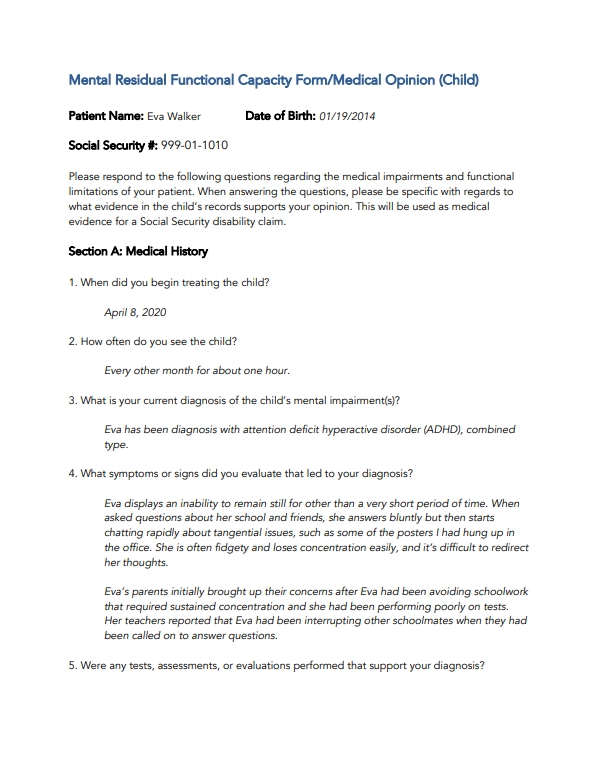
For your child to have their best shot at getting SSI benefits, it's very beneficial to have a medical source statement written by your child's pediatrician, family care provider, or mental health specialist. You can click on the thumbnail below to see a sample of a useful doctor's statement for a child with ADHD.
Family Income and Asset Limits for SSI
Children can qualify for disability benefits only through the SSI program, which has strict income and assets limits. Children are not eligible for Social Security disability insurance (SSDI) benefits. (Learn about the difference between SSI and SSDI.)
A child's parent's income will be partly counted toward the SSI income limit. In addition, older children can't earn more than $1,690 per month at a job (as of 2026) and still qualify for SSI. For more information, see our section on SSI eligibility.
How Much SSI Does a Child With ADHD Get?
The maximum SSI amount, in 2026, is $994, but few children who receive SSI get that amount. The average SSI payment that Social Security paid to children (in 2025) was $813.
The average amount is lower than the maximum because the SSA reduces the SSI amount if the child or parent has any income. But not all of a parent's income is counted. For instance, the SSA doesn't count half of the wages a parent makes, and the agency also makes an allocation for the living expenses of the parent and any other children living in the house. Read our article on family income to find out exactly how the SSA calculates a child's income.
How Difficult Is It to Get Disability Benefits for ADHD?
It's not easy to get disability benefits for a child with ADHD. Part of the problem has to do with the subjective nature of how Social Security evaluates the condition. Most medical consultants who decide mental disability claims at the application level rely on the subjective observations of others (mostly teachers) to determine whether a child has an impairment and how severe it is.
Observations of behavior, of course, are always open to interpretation. In actuality, the only objective standards for evaluating ADHD disability claims are a student's school records and the results of standardized psychological testing. As a result, whether or not a child is found eligible for disability benefits almost always depends on their academics; that is, how well they're doing in school.
To win an ADHD disability claim, it's not enough to be given an ADHD diagnosis. Your child must also have measurable functional deficits in the context of school performance. Suppose a child has adequate (grade-level) performance at school but has severe ADHD symptoms at home, even with accompanying serious behavioral issues due to impulsivity and poor decision-making. The child is unlikely to qualify for benefits.
Tips on Getting Disability for Your Child With ADHD
There are three factors that might help your child get approved for SSI disability benefits for their ADHD.
Make Sure Your Child Gets Proper Medical Treatment
An ADHD diagnosis by a family doctor or pediatrician doesn't hold much weight with the SSA. The agency wants to see that your child has been evaluated for ADHD by a mental health professional, given a formal ADHD assessment, and diagnosed with ADHD. Some child psychologists specialize in ADHD assessments, and you might be able to get an ADHD assessment through your health insurance, simply by paying a copay for an office visit.
Is Your Child Taking Medication?
The listing for ADHD doesn't require that your child take medication, and having a prescription for Ritalin or Adderal isn't enough on its own to get disability benefits. However, most disability claims examiners and administrative law judges (ALJs) will review a child's medical records to see if they're taking prescription medication. If your child isn't, it may be a sign to Social Security that your child's ADHD isn't that severe.
If your child does have a prescription for ADHD medicine, note that a child whose social, communicative, or cognitive problems only appear when they don't take their prescribed medication doesn't have a great chance of getting disability benefits.
Have Your Child Tested at School
While testing by a mental health professional can confirm the existence of ADHD in a child, school testing can serve another purpose. School testing can determine whether or not a child will receive individualized attention in the classroom and/or be classified as a special needs student. Having an individualized education plan (IEP) that provides your child with educational services can show a disability claims examiner or judge that a child's ADHD-related problems are significant enough to warrant special attention.
For the majority of disability claims filed for ADHD, Social Security's determination will be based on how well a child does academically in relation to his or her peers. If a child performs at grade level, it's difficult to make a strong case for awarding disability even though that child's behavior outside the classroom may be problematic.
How to Apply for SSI Benefits for Your Child
Applying for SSI disability benefits for your child is a two-step process. First, you should complete the online Child Disability Report, which asks how your child's condition affects his or her ability to function. (Before applying, be sure to review the SSI Child Disability Starter Kit on the SSA website.) If you don't feel comfortable filling out the report online, you can call Social Security at 800-772-1213 to set up an appointment, or simply walk into your local Social Security office.
After you've submitted the Child Disability Report, an SSA representative will call you to discuss the income and asset limits for the program and start the SSI application process.
You'll usually receive an initial decision on your application within three to five months. If your child is denied SSI, you have the right to appeal.
Getting Help With a Child's SSI Application
Social Security is flooded with SSI applications for children with ADHD, and most of them are denied. Only those with the most severe and well-documented cases of ADHD are awarded benefits.
To maximize your chances of success, you might also consider hiring a disability representative. Families who hire a lawyer to appeal a denial of benefits for ADHD have a higher approval rate than those who don't, because disability lawyers know how the system works and what kind of evidence is most persuasive to Social Security. Disability advocates and lawyers generally offer free consultations and only get paid if you win your case.

In This Article
- Is a Child's ADHD a Disability?
- Supporting Evidence for a Disability Claim Based on ADHD or ADD
- Family Income and Asset Limits for SSI
- How Much SSI Does a Child With ADHD Get?
- How Difficult Is It to Get Disability Benefits for ADHD?
- Tips on Getting Disability for Your Child With ADHD
- How to Apply for SSI Benefits for Your Child
- Getting Help With a Child's SSI Application