
While the main difference between short-term and long-term disability is how long the insurance coverage lasts, there are other factors that you should be aware of in order to protect your benefits.
Written and Edited by Lawyers
All articles on DisabilitySecrets.com have been written or edited and fact-checked by our in-house attorney editors, who together have over 35 years of experience practicing and covering disability law. Learn more about our team and our editorial standards.
As the names “short-term” and “long-term” disability suggest, the major difference between the two types of insurance depends on the length of time you can receive payments. Short-term disability often lasts for a few weeks or months, while long-term disability can last for years or even until retirement. Both short- and long-term disability insurers provide wage replacement at a portion of your usual salary until you can return to work.
Few people are fortunate enough to make it through their working years without needing to take some time off due to an illness or injury. Health insurance can help cover your medical bills, but in order to pay for your housing, food, and other expenses, you may need to file a claim for short-term or long-term disability insurance. If you’re thinking of taking time off to recover from a health issue, it’s important to understand the other main differences between these kinds of insurance policies in order to determine which is best suited for your needs.
In This Article
- Key Differences Between Short-Term and Long-Term Disability Insurance
- Which Pays More, Short-Term or Long-Term Disability?
- Employer-Provided vs. Individual Disability Insurance
- Can I Get Both Short-Term and Long-Term Disability?
- How to Apply for Short-Term or Long-Term Disability
- What Are My Options If My Claim Was Denied or I Don’t Have Disability Insurance?
Key Differences Between Short-Term and Long-Term Disability Insurance
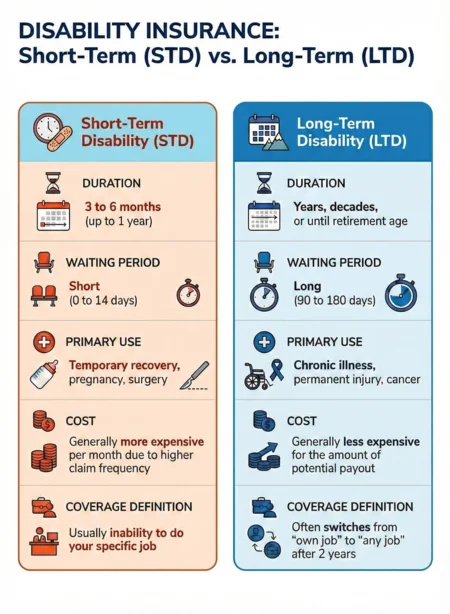
While both short-term and long-term disability policies can replace part of your income while you’re off work for health reasons, they operate on different durational periods, may have separate filing procedures, and don’t always cover the same kinds of conditions.
Duration of Benefits
Short-term disability benefits typically last up to a maximum of three to six months. Long-term disability coverage lasts for years, potentially decades (if you become disabled at a young age and your policy covers you until you retire).
Waiting Period
Both short- and long-term disability policies usually have a “waiting” or “elimination” period between the time you become disabled and the time you can start receiving benefits. Unsurprisingly, the waiting period is generally less for short-term disability (typically a week or two, although some policies begin paying immediately and others make you wait a month) than it is for long-term disability (which usually has a waiting period of several months).
Primary Use
Short-term disability benefits are mainly used for conditions that you’re expected to recover from fairly quickly, such as surgery or pregnancy. Long-term disability benefits provide coverage for conditions that you need more time to heal from or permanent conditions like chronic illnesses.
Cost of Premiums
Short-term disability premiums are generally higher since more claims are filed for short-term benefits. Long-term disability premiums can be lower since fewer claims for this type of coverage are filed.
Definition of Disability
Short-term disability policies usually consider you disabled when you’re unable to perform the duties of your “own occupation” (your regular line of work, such as accountant, mechanic, or musician). Long-term disability policies often start off by considering you disabled when you can’t perform your own occupation, but after a certain period of time—typically when you’ve been receiving benefits for two years—the policy will only pay out if you’re unable to perform the duties of “any occupation” to which you’re reasonably suited.
Which Pays More, Short-Term or Long-Term Disability?
It depends on your exact policy, but short-term and long-term disability policies usually provide for wage replacement payments at a percentage rate between 40-80% of your salary. Very few disability insurance policies replace 100% of your income. (Those that do are often the result of special “riders,” or add-ons to the basic policy, and usually only cover special situations.) That’s because the purpose of disability insurance is to allow you to maintain your standard of living without disincentivizing a return to work.
Employer-Provided vs. Individual Disability Insurance
Employees may be offered short- or long-term disability insurance plans as part of a compensation package from their employer. Independent contractors or employees who don’t have this employer-provided benefit can choose to purchase individual disability insurance plans on their own.
One major difference between employer-provided and individually purchased disability insurance policies is that employer-provided plans are governed by a federal law known as ERISA. (29 U.S.C. §1002 (2026).) Insurance claims arising under ERISA have to follow specific procedures and have certain protections that aren’t available with individually purchased claims.
Other important distinctions include the following:
- Tax consequences. Employer-provided disability insurance payments may be taxable, while individual insurance plan payments are typically tax-free.
- Premium costs. ERISA plans are generally subsidized—meaning your employer pays part of the premiums—while individual plans are usually paid wholly out of pocket.
- Portability. Employer-provided coverage is tied directly to your job and ends when you leave, while individual plans belong to you and stay with you regardless of employment.
You can have both employer-provided and individually purchased plans at the same time if you want more comprehensive insurance coverage than you’d get by just having one type of plan.
Can I Get Both Short-Term and Long-Term Disability?
Yes. Short-term disability insurance is meant to provide income for several weeks or months while you recover from an illness or injury, while long-term policies are there for extended or permanent disabilities. These types of insurance are designed to work together sequentially, so if you’re still unable to return to work as you reach the end of your short-term disability term, your long-term disability policy should kick in, leaving you without any income gaps.
To ensure a smooth transition between short- and long-term disability benefits, it helps if you plan ahead. If you have the same insurance carrier for both policies, you might not need to do much (since the insurer will already have your medical files), but you’ll still probably need to file a separate long-term disability claim. You should start this process about two to three months before your short-term benefits expire. Keep in mind that getting short-term disability doesn’t automatically mean that you’ll get long-term disability too—you’ll still need to meet the requirements of the long-term disability policy.
How to Apply for Short-Term or Long-Term Disability
The first move towards getting short- or long-term disability benefits is filing a claim with your insurer. You can find a step-by-step guide to each kind of claim in our articles on preparing and filing your short-term disability claim and how to file a long-term disability claim.
When you’re ready to file, make sure that you have copies of your relevant records—your doctor’s medical source statement, for example—before you submit your disability claim. That way if the insurance company doesn’t receive or misplaces this information, you can have a backup at the ready.
What Are My Options If My Claim Was Denied or I Don’t Have Disability Insurance?
Whether you have individually purchased or employer-provided insurance coverage, it doesn’t have to be the end of the road if your disability claim was denied. You can appeal the decision, preferably with help from an experienced disability attorney.
If your employer doesn’t provide short- or long-term disability insurance and you haven’t bought your own plan, you still have options to help you financially. Some states offer publicly funded temporary disability insurance, while others have paid family and medical leave. And if you’ve been unable to work full-time for at least one year due to your medical condition, you may qualify for Social Security disability benefits.
Talk to a Lawyer
Need a lawyer? Start here.
How it Works
- Briefly tell us about your case
- Provide your contact information
- Choose attorneys to contact you
In This Article
- Key Differences Between Short-Term and Long-Term Disability Insurance
- Which Pays More, Short-Term or Long-Term Disability?
- Employer-Provided vs. Individual Disability Insurance
- Can I Get Both Short-Term and Long-Term Disability?
- How to Apply for Short-Term or Long-Term Disability
- What Are My Options If My Claim Was Denied or I Don’t Have Disability Insurance?